
Steering Wheel Shakes When Braking: Causes, Diagnosis & Fixes
If your steering wheel shakes or vibrates when you hit the brakes, don’t ignore it. Learn the most common causes, how to diagnose them at home, and the best ways to fix a shaking steering wheel under braking....


If your steering wheel shakes when you hit the brakes, that vibration is your car’s way of telling you something is wrong. Sometimes it’s a minor issue like uneven tire wear, but it can also point to serious brake or suspension problems that affect safety and stopping distance.
- 1. Is a Shaking Steering Wheel While Braking Dangerous?
- 2. Main Causes of Steering Wheel Shaking While Braking
- 2.1. 1. Warped or Uneven Front Brake Rotors
- 2.2. 2. Worn or Glazed Brake Pads
- 2.3. 3. Sticking or Uneven Front Brake Calipers
- 2.4. 4. Loose, Bent, or Out-of-Balance Front Wheels
- 2.5. 5. Worn Front Suspension or Steering Components
- 2.6. 6. Alignment Problems and Uneven Tire Wear
- 3. How to Diagnose Steering Wheel Shaking Under Braking
- 3.1. Step 1: Pay Attention to When the Vibration Happens
- 3.2. Step 2: Visual Inspection of Wheels and Tires
- 3.3. Step 3: Inspect Brake Rotors and Pads
- 3.4. Step 4: Check Caliper Operation
- 3.5. Step 5: Inspect Suspension and Steering Components
- 4. How to Fix a Steering Wheel That Shakes When Braking
- 4.1. 1. Properly Torque Lug Nuts
- 4.2. 2. Replace or Resurface Front Brake Rotors
- 4.3. 3. Replace Worn or Glazed Brake Pads
- 4.4. 4. Repair or Replace Sticking Calipers
- 4.5. 5. Balance or Replace Damaged Wheels and Tires
- 4.6. 6. Replace Worn Suspension or Steering Components
- 5. DIY vs Professional Repair: When to Get Help
- 5.1. Good DIY Tasks
- 5.2. Best Left to a Professional
- 6. How to Prevent Steering Wheel Vibration When Braking
- 7. Frequently Asked Questions
- 7.1. Can warped rotors fix themselves?
- 7.2. Why does my steering wheel shake only at high speed when braking?
- 7.3. Is it safe to drive with a shaking steering wheel when braking?
- 7.4. Why does my car shake when accelerating and braking?
This guide explains why your steering wheel shakes while braking, how to tell whether it’s a brake, wheel, or suspension issue, and what you can do to diagnose and fix it before it becomes dangerous or expensive.
Is a Shaking Steering Wheel While Braking Dangerous?
Yes, it can be. A slight, occasional shimmy at very high speeds might not be an emergency, but consistent or strong shaking under braking usually means:

- Reduced braking efficiency – warped or uneven rotors can increase stopping distance.
- Unstable steering – vibrations can make it harder to keep the car straight in an emergency stop.
- Accelerated wear – bad rotors, pads, or suspension components can quickly damage other parts.
If the steering wheel shakes only when you apply the brakes, focus your diagnosis on the front brakes and front suspension. If the whole car shakes under acceleration instead, that’s a different problem – see our guide on car shakes when accelerating.
Main Causes of Steering Wheel Shaking While Braking
Most of the time, a shaking steering wheel under braking comes down to one of these issues:
1. Warped or Uneven Front Brake Rotors
This is the most common cause. Brake rotors (discs) need to be flat and parallel. When they become uneven, the brake pads grab harder on some spots than others as the rotor spins. That uneven friction is felt as a pulsing or shaking in the steering wheel when you press the brake pedal.
- Typical symptoms:
- Steering wheel shakes mainly at higher speeds (50–70 mph / 80–110 km/h) when braking.
- Brake pedal may pulse up and down under your foot.
- No vibration when coasting or accelerating at the same speed.
- Common causes of warped rotors:
- Overheating from repeated hard braking or towing.
- Cheap or low-quality rotors that can’t handle heat cycles.
- Improper wheel lug nut torque (over-tightened or uneven).
- Leaving the car parked with very hot brakes (pads can imprint on the rotor).
Sometimes rotors aren’t truly “warped” but have thickness variation or uneven pad deposits. The effect is the same: vibration under braking.
2. Worn or Glazed Brake Pads
Brake pads that are worn down, cracked, or glazed (hardened and shiny from overheating) can grab the rotor unevenly. That can create vibration you feel in the steering wheel, especially if the issue is worse on one side of the car.
- Typical symptoms:
- Shaking while braking, sometimes accompanied by squealing or grinding.
- Uneven pad wear between left and right front wheels.
- Brake dust heavier on one front wheel.
- Why it happens:
- Low-quality pads that overheat easily.
- Dragging caliper causing one pad to overheat and glaze.
- Ignoring pads until they’re nearly worn out.
3. Sticking or Uneven Front Brake Calipers
The caliper squeezes the brake pads against the rotor. If one caliper is sticking, seized, or its slide pins are corroded, it can apply uneven pressure, pulling the car slightly to one side and causing vibration in the steering wheel.
- Typical symptoms:
- Steering wheel shakes and car may pull to one side when braking.
- One front wheel is much hotter than the other after driving.
- Burning smell from one corner of the car.
- Uneven brake pad wear (one pad worn much more than the other).
4. Loose, Bent, or Out-of-Balance Front Wheels
Although wheel balance usually causes vibration while cruising, it can also show up more noticeably when braking, especially if there’s also a rotor issue. Loose lug nuts or a bent wheel can exaggerate the shake when the brakes are applied.
- Typical symptoms:
- Vibration at certain speeds that gets worse when braking.
- Steering wheel shimmy even without braking if the imbalance is severe.
- Visible wobble of the wheel when spun on a balancer or while jacked up.
- Danger sign: Loose lug nuts can lead to wheel separation – check this immediately if you recently had tires or brakes serviced.
5. Worn Front Suspension or Steering Components
Loose or worn suspension parts let the wheel and hub move more than they should. When you brake, the force on those loose components can cause the steering wheel to shake.
- Common culprits:
- Worn tie rod ends (inner or outer).
- Loose or worn ball joints.
- Worn control arm bushings.
- Worn steering rack mounts.
- Typical symptoms:
- Clunking or knocking noises over bumps or when braking.
- Steering feels loose or vague.
- Uneven tire wear on the front tires.
- Car wanders or needs constant correction on the highway.
6. Alignment Problems and Uneven Tire Wear
Bad alignment doesn’t usually cause vibration by itself, but it leads to uneven tire wear. A tire with flat spots, cupping, or severe feathering can vibrate, and braking loads can make that vibration more noticeable through the steering wheel.
- Typical symptoms:
- Steering wheel slightly off-center when driving straight.
- Uneven or scalloped tread wear on front tires.
- Vibration that’s worse at certain speeds and under braking.
How to Diagnose Steering Wheel Shaking Under Braking
You can do a lot of basic diagnosis at home with simple tools. Here’s a step-by-step approach.
Step 1: Pay Attention to When the Vibration Happens
- Only when braking? Most likely rotors, pads, or calipers.
- While accelerating but not braking? That points more to drivetrain or engine issues – see car jerks when accelerating for a different set of causes.
- At certain speeds even without braking? Wheel balance, bent wheel, or tire issues.
- Vibration in the brake pedal too? Strongly suggests rotor problems.
Step 2: Visual Inspection of Wheels and Tires
- Check that all lug nuts are present and properly tightened. If any are loose, torque them to the manufacturer’s spec as soon as possible.
- Inspect tires for bulges, flat spots, or uneven wear. Run your hand lightly over the tread – it should feel even and smooth.
- Look for visible bends or cracks in the wheel rim.
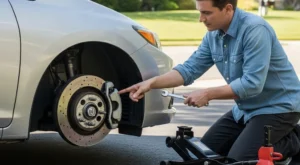
Step 3: Inspect Brake Rotors and Pads
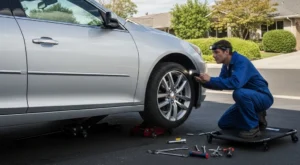
You’ll need to remove the front wheels for this. Use jack stands and follow all safety precautions.
- Rotors:
- Look for blue spots or discoloration – signs of overheating.
- Run your finger along the rotor surface (when cool). It should feel relatively smooth, not deeply grooved or wavy.
- Check for rust lips at the edges, which indicate wear.
- Pads:
- Check pad thickness – most manufacturers recommend replacement around 3–4 mm.
- Look for uneven wear between inner and outer pads on the same wheel.
- Glazed pads will look shiny and feel hard instead of slightly rough.
Step 4: Check Caliper Operation
- After a short drive with several moderate stops, carefully feel near (not directly on) each front wheel.
- If one wheel is much hotter than the other, that caliper may be sticking.
- With the wheel off, inspect the caliper slide pins for rust and lack of lubrication.
- Check the rubber boots for tears that could let moisture in.
Step 5: Inspect Suspension and Steering Components
With the front end safely lifted and supported:
- Grab the tire at 3 and 9 o’clock and wiggle it.
- Play here can indicate worn tie rod ends or steering rack issues.
- Grab the tire at 12 and 6 o’clock and wiggle it.
- Movement can point to worn ball joints or wheel bearings.
- Look at control arm bushings for cracks, tears, or excessive movement.
How to Fix a Steering Wheel That Shakes When Braking
The correct fix depends on what you find during diagnosis. Here are the most common repairs, from simplest to more involved.
1. Properly Torque Lug Nuts
If you discover loose or unevenly tightened lug nuts, this is the first thing to fix.
- Use a torque wrench and tighten in a star pattern to the manufacturer’s specification (usually 80–100 ft-lb for many passenger cars, but always check your manual).
- Improper torque can distort the rotor and cause vibration under braking.
2. Replace or Resurface Front Brake Rotors
If rotors are warped or have thickness variation, they need to be corrected.
- Resurfacing (machining):
- Viable if the rotor still has enough thickness after machining.
- Not recommended if rotors are already thin or heavily heat-checked.
- Replacement:
- Often the better long-term fix, especially with severe vibration.
- Always replace rotors in pairs (both front wheels) to keep braking balanced.
Whenever you replace rotors, it’s wise to install new brake pads at the same time so the new surfaces can bed in together.
3. Replace Worn or Glazed Brake Pads
If pads are worn, cracked, or glazed:
- Replace pads on both front wheels as a set.
- Clean the caliper bracket and hardware, and lubricate slide points with high-temperature brake grease.
- Follow proper bedding-in procedure for new pads and rotors to prevent uneven deposits.
4. Repair or Replace Sticking Calipers
For sticking calipers or seized slide pins:
- Remove and clean slide pins; replace if pitted or badly corroded.
- Lubricate pins with the correct high-temp silicone or synthetic brake grease.
- If the caliper piston is seized or the boot is torn, a caliper rebuild or replacement is usually required.
Always bleed the brake system after caliper replacement to remove air from the lines.
5. Balance or Replace Damaged Wheels and Tires
If inspection shows wheel or tire issues:
- Have all four wheels professionally balanced.
- Replace any bent wheels or tires with bulges or exposed cords.
- Rotate tires if uneven wear is minor and alignment is corrected.
6. Replace Worn Suspension or Steering Components
Loose suspension parts can amplify brake vibration and create their own shakes and noises.
- Replace worn tie rod ends, ball joints, or control arm bushings as needed.
- After suspension work, always get a four-wheel alignment to protect your tires and restore proper handling.
DIY vs Professional Repair: When to Get Help
Some fixes are well within reach of a careful DIYer with basic tools, while others are better left to a professional.
Good DIY Tasks
- Checking tire pressure and visual tire inspection.
- Verifying and correcting lug nut torque.
- Inspecting pads and rotors for obvious damage or wear.
- Replacing pads and rotors on many vehicles (with proper tools and guidance).
Best Left to a Professional
- Diagnosing complex suspension or steering play.
- Replacing ball joints, tie rods, or control arms.
- Brake hydraulic issues (leaking lines, master cylinder problems).
- Wheel alignment and advanced ABS-related faults.
If your steering wheel shake is accompanied by other symptoms like jerking, hesitation, or starting issues, you may be dealing with multiple problems. For example, if the car also struggles to start, review our guide on car won’t start but battery is good to rule out separate electrical or fuel issues.
How to Prevent Steering Wheel Vibration When Braking
Once you’ve fixed the problem, a few habits can help you avoid it returning:
- Use quality brake parts: Good pads and rotors handle heat better and are less likely to warp or glaze.
- Torque wheels correctly: Always use a torque wrench after tire or brake work.
- Avoid riding the brakes: On long downhill stretches, use engine braking (lower gears) to reduce heat buildup.
- Service brakes regularly: Inspect pads, rotors, and calipers at least once a year or every 12,000 miles (20,000 km).
- Maintain alignment and suspension: Fix worn components early to prevent uneven tire wear and vibration.
Frequently Asked Questions
Can warped rotors fix themselves?
No. Once rotors are warped or have significant thickness variation, they won’t straighten out with normal driving. They must be resurfaced (if still within spec) or replaced.
Why does my steering wheel shake only at high speed when braking?
High-speed braking puts more heat and force into the front brakes, so rotor imperfections show up more strongly. Slightly warped rotors may only be noticeable when braking from highway speeds.
Is it safe to drive with a shaking steering wheel when braking?
Short-term, gentle driving might be possible, but it’s not ideal. Vibration indicates your braking system or front suspension isn’t working correctly, which can increase stopping distance and reduce control. Schedule inspection and repair as soon as you can.
Why does my car shake when accelerating and braking?
If you feel shaking both under acceleration and braking, you may have more than one issue – for example, a drivetrain or engine problem plus warped rotors. Start by separating the symptoms: note when the vibration is worst, then diagnose each condition separately using resources like our detailed guides on car shakes when accelerating and brake-specific checks above.
A steering wheel that shakes when braking is more than just an annoyance – it’s a warning sign. By understanding the common causes, performing basic checks, and addressing issues early, you can restore smooth, confident braking and avoid more expensive repairs down the road.
How do you rate this guide?

Related Posts
Comments have been disabled.
