OBD2 Code P0420 for Beginners: Catalytic Converter Efficiency, Symptoms, and Simple First Checks
OBD2 code P0420 points to low catalytic converter efficiency, but that doesn’t always mean you need a new cat. Learn what it really means, common symptoms, and simple checks you can do at home before spending big money....


OBD2 code P0420 can be intimidating because it sounds expensive and often gets blamed on a “bad catalytic converter.” In reality, this code is the computer telling you the catalytic converter system is not cleaning up exhaust gases as well as it should on Bank 1. That can be caused by the converter itself, but also by sensors, exhaust leaks, or even old engine problems.
- 1. What OBD2 Code P0420 Actually Means
- 2. Common Symptoms of P0420 (and When You May Not Notice Any)
- 3. How Serious Is P0420? Can You Keep Driving?
- 4. Most Common Causes of OBD2 Code P0420
- 4.1. 1. Actual Catalytic Converter Failure
- 4.2. 2. Faulty Oxygen Sensors (Upstream or Downstream)
- 4.3. 3. Exhaust Leaks Near the O2 Sensors or Converter
- 4.4. 4. Engine Problems That Damage or Overload the Converter
- 5. Simple First Checks for P0420 You Can Do at Home
- 5.1. Step 1: Confirm the Code and Look for Other Trouble Codes
- 5.2. Step 2: Do a Quick Visual Exhaust Inspection
- 5.3. Step 3: Check for Engine Performance Issues
- 5.4. Step 4: Consider Fuel Quality and Driving Habits
- 6. When It Might Be the Catalytic Converter (and When It Probably Isn’t)
- 7. Basic DIY Steps You Can Try Before Replacing the Converter
- 8. When to See a Mechanic for P0420
- 9. Summary and Next Steps
This beginner-friendly guide explains what P0420 means, common symptoms, how serious it is, and step-by-step checks you can safely do at home before authorizing a costly repair.
What OBD2 Code P0420 Actually Means


P0420 is defined as “Catalyst System Efficiency Below Threshold (Bank 1).” Bank 1 is the side of the engine that contains cylinder 1. On inline 4-cylinder engines, there is usually only one bank, so Bank 1 is the entire engine.
Your car uses oxygen sensors (O2 sensors) before and after the catalytic converter to measure how well the converter is reducing harmful gases. The engine computer compares the signals from these sensors. If the downstream sensor (after the cat) starts to look too similar to the upstream sensor (before the cat) over time, the computer decides the converter is not doing its job and sets P0420.
In simple terms: the computer thinks the catalytic converter on Bank 1 is not cleaning the exhaust as much as it should.
Common Symptoms of P0420 (and When You May Not Notice Any)
P0420 can be sneaky. Sometimes the only sign is a check engine light. Other times, you will notice clear drivability issues.
- Check engine light on (steady): The most common symptom. The car may still drive normally.
- Failed emissions test: High NOx, HC, or CO readings can go along with P0420.
- Reduced fuel economy: The engine may run slightly richer or less efficiently if the converter or sensors are not working correctly.
- Sluggish acceleration or lack of power at higher speeds: A severely clogged catalytic converter can restrict exhaust flow.
- Rotten egg or sulfur smell from exhaust: Indicates fuel mixture or catalyst issues.
- Rattling noise under the car: A broken catalytic converter substrate can rattle, especially on startup or when revving.
Many drivers only see the light and feel no difference. That’s why it’s important not to ignore P0420, even if the car seems fine. Long-term driving with an inefficient or failing converter can lead to more expensive problems.
How Serious Is P0420? Can You Keep Driving?
P0420 is usually moderately serious. In most cases, you can continue driving for a short time without immediate danger, but there are important caveats.
- Generally safe to drive short-term: If the car runs smoothly, with no misfires, no overheating, and no strong exhaust restriction, you can drive to work or to a shop.
- Do not ignore misfires or rough running: If the engine is misfiring or running very rich, unburned fuel can overheat and destroy the catalytic converter. Fix misfires and fueling issues first.
- Watch for power loss: If the car struggles to accelerate, especially up hills or at highway speeds, the converter may be clogged. In that case, limit driving and get it checked quickly.
- Check local emissions laws: In many areas, an illuminated check engine light and stored P0420 will cause an automatic emissions test failure.
Think of P0420 as a warning that something in the exhaust-cleanup chain is not right. It may not be an emergency today, but ignoring it can turn into a very expensive catalytic converter replacement or even engine damage later.
Most Common Causes of OBD2 Code P0420
P0420 does not always mean the catalytic converter itself is bad. Before assuming the worst, understand the full list of likely causes.
1. Actual Catalytic Converter Failure
- Normal wear and tear: Catalytic converters slowly lose efficiency over high mileage, especially if the engine has not been perfectly tuned.
- Damage from misfires or rich mixture: Long-term misfires, oil burning, or coolant leaks into the combustion chamber can overheat and poison the catalyst.
- Physical damage: Impacts from road debris or off-road driving can crack the converter housing or internal substrate.
If the converter is truly worn out, replacement is usually the only long-term fix. But you want to be sure before spending that money.
2. Faulty Oxygen Sensors (Upstream or Downstream)
- Slow or lazy O2 sensors: Sensors that respond slowly can trick the computer into thinking the converter is inefficient.
- Contaminated sensors: Oil, coolant, or silicone-based sealants can coat the sensor tip and change readings.
- Wiring or connector issues: Corroded connectors or damaged wiring can cause incorrect signals.
Often, a weak downstream O2 sensor (after the catalytic converter) is mistaken for a bad converter. Testing or replacing a suspect sensor is usually cheaper than replacing the cat.
3. Exhaust Leaks Near the O2 Sensors or Converter
- Cracked exhaust manifold or flex pipe: Leaks before or near the O2 sensors can pull in outside air and confuse sensor readings.
- Leaking gaskets or flanges: Small leaks around joints can still affect the O2 sensor data.
- Rust holes in pipes: Common in older vehicles in rust-prone areas.
Any leak that lets fresh air into the exhaust stream can make the computer think the converter is not working properly.
4. Engine Problems That Damage or Overload the Converter
- Unfixed misfire codes (like P030X): Misfires send raw fuel into the exhaust, overheating the converter.
- Rich fuel mixture: Faulty fuel injectors, fuel pressure regulators, or sensors (like MAF) can cause rich running.
- Oil or coolant consumption: Worn piston rings, valve seals, or head gaskets can contaminate the converter.
If you also have other codes or symptoms (rough running, hard starts, poor fuel economy), those must be fixed first. Otherwise, any new converter will quickly fail again.
Simple First Checks for P0420 You Can Do at Home

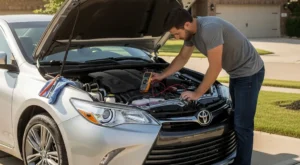
Before you agree to an expensive catalytic converter replacement, there are several safe checks you can do yourself. You will need an OBD2 scanner (even a basic Bluetooth one) and a flashlight. If you already own a scanner from diagnosing other issues like car won’t start in cold weather, you can use the same tool here.
Step 1: Confirm the Code and Look for Other Trouble Codes
- Plug in your OBD2 scanner: Turn the key to the ON position (engine off) and connect the scanner to the OBD2 port, usually under the dash.
- Read all stored and pending codes: Write them down. Look for other codes besides P0420, especially misfire codes (P0300–P030X), fuel trim codes, or O2 sensor codes (P013X, P014X).
- Do not clear codes yet: You want to keep the freeze-frame data (the conditions when the code set) until you or a mechanic have reviewed it.
If you see misfire or fuel-related codes along with P0420, those are often the root cause and should be addressed first.
Step 2: Do a Quick Visual Exhaust Inspection
- Let the exhaust cool: If you just drove the car, wait at least 30–45 minutes. Exhaust components can be extremely hot.
- Safely raise the car if needed: Use a jack and jack stands on solid ground if you need more room. Never rely on a jack alone.
- Follow the exhaust path: Start at the engine, follow the exhaust manifold, flex pipe, catalytic converter, and pipes toward the rear.
- Look and listen for leaks: Rust holes, black soot marks around joints, or obvious cracks are signs of leaks. You may hear a ticking or puffing sound when the engine is running.
- Check O2 sensor wiring: Make sure the wires to the sensors are intact, not melted, pinched, or hanging loose.
Any obvious exhaust leak near the converter or O2 sensors should be fixed before condemning the catalytic converter.
Step 3: Check for Engine Performance Issues
- Start the engine and listen: It should idle smoothly without shaking or misfiring.
- Check for unusual smells: A strong fuel smell or rotten egg odor can indicate mixture or converter problems.
- Test drive gently: On a safe road, accelerate normally. Note any hesitation, lack of power, or surging.
- Pay attention to vibrations: If you feel vibrations that change with speed, you may also want to review guidance like Car Vibrates While Driving – Causes, Diagnosis & Fixes, as those issues can be separate from P0420.
If the engine is not running smoothly, fix that first. A rough engine can be the cause of P0420, not just a side effect.
Step 4: Consider Fuel Quality and Driving Habits
- Think about recent fuel: Poor-quality or contaminated fuel can temporarily affect sensor readings and converter efficiency.
- Review your driving pattern: Short trips and constant stop-and-go driving can prevent the converter from reaching full operating temperature regularly.
- Take a longer highway drive: A 20–30 minute highway drive at steady speed can help burn off deposits and allow the converter to operate efficiently.
- Re-scan after a few drive cycles: If P0420 does not return after several trips, it may have been a temporary condition.
While this won’t fix a truly failing converter, it can clear up borderline efficiency issues caused by short-trip driving.
When It Might Be the Catalytic Converter (and When It Probably Isn’t)
Because catalytic converters are expensive, you want to be as confident as possible before replacing one. Here are some general guidelines.
- More likely the converter is bad if:
- The car has high mileage (150,000+ miles) and P0420 keeps returning after other issues are fixed.
- There are no other active codes, and the engine runs smoothly.
- A mechanic has confirmed O2 sensors are working and there are no exhaust leaks.
- You notice reduced power at higher speeds or uphill, and possibly a rattling noise from the converter.
- Less likely the converter is bad if:
- You have other active codes (misfires, rich/lean, O2 sensor codes).
- The car recently had engine problems like a blown head gasket, heavy oil burning, or long-term misfires.
- The exhaust system is rusty or has visible leaks near the converter or sensors.
- The downstream O2 sensor is old or has never been replaced on a high-mileage vehicle.
In many cases, replacing a weak downstream O2 sensor and fixing leaks or fueling issues can resolve P0420 without replacing the catalytic converter.
Basic DIY Steps You Can Try Before Replacing the Converter
If your checks haven’t revealed anything obvious and the car runs well, there are a few practical steps you can take before committing to a new converter. These won’t fix a truly dead catalytic converter, but they can help rule out simpler causes.
- Address any other codes first: If you have misfire, fuel trim, or O2 sensor codes, fix those issues before worrying about P0420.
- Repair obvious exhaust leaks: Have a shop weld or replace leaking sections, gaskets, or flanges near the converter or sensors.
- Replace an old downstream O2 sensor (if mileage is high): On many vehicles, the rear O2 sensor is considered a maintenance item around 100,000–150,000 miles. If it’s original, replacing it can be a smart preventive step.
- Use quality fuel and give the car a proper drive: Fill up with quality fuel and take a longer highway drive to let the converter reach and maintain full operating temperature.
- Clear the code and monitor: After repairs, clear the code with your scanner and drive normally for several days. If P0420 does not return, you may have solved the problem.
If P0420 comes back consistently after these steps, it’s time to get a more detailed diagnosis or consider catalytic converter replacement.
When to See a Mechanic for P0420
Some tests require tools and experience beyond a beginner level, such as measuring backpressure, checking live O2 sensor waveforms, or performing advanced emissions diagnostics. You should see a qualified mechanic when:
- The car has noticeable power loss, overheating exhaust components, or a strong rotten egg smell.
- P0420 returns quickly after clearing, even after fixing other codes and leaks.
- You are due for an emissions test soon and need a reliable pass.
- You suspect internal engine issues (heavy oil use, coolant loss with white smoke, repeated misfires).
Explain to the mechanic what checks you’ve already done. This can save diagnostic time and help them focus on the remaining possibilities.
Summary and Next Steps
OBD2 code P0420 means the computer believes your Bank 1 catalytic converter is not cleaning exhaust gases efficiently, but the converter itself is only one piece of the puzzle. Exhaust leaks, aging O2 sensors, and unresolved engine problems can all trigger this code.
Start with simple checks: scan for additional codes, inspect the exhaust for leaks, evaluate how the engine runs, and consider your driving habits. Fix any misfires or fuel issues first, repair leaks, and replace an obviously tired downstream O2 sensor before committing to a new catalytic converter.
If P0420 keeps coming back, or if you notice power loss, overheating, or other worrying symptoms, schedule a professional diagnosis. Catching the root cause early can save you from repeated converter failures and much higher repair bills down the road.
How do you rate this guide?

Related Posts
Comments have been disabled.