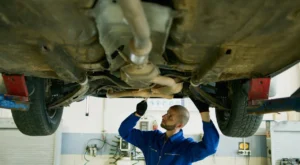
OBD2 Code P0420: Catalyst System Efficiency Below Threshold – Causes, Diagnosis & Fixes
OBD2 code P0420 means your catalytic converter system isn’t working efficiently enough. Learn what P0420 really means, common causes, how to diagnose it at home, when you actually need a new catalytic converter, and how to avoid wasting money on guesswork repairs....


- 1. What Does OBD2 Code P0420 Mean?
- 2. Is P0420 Serious? Can You Still Drive?
- 3. Common Symptoms of P0420
- 4. Main Causes of OBD2 Code P0420
- 4.1. 1. Actual Catalytic Converter Failure
- 4.2. 2. Faulty Oxygen (O2) Sensors or Wiring
- 4.3. 3. Fuel Mixture or Combustion Problems
- 4.4. 4. Exhaust Leaks
- 4.5. 5. Software / Calibration Issues
- 5. How to Diagnose P0420 Step-by-Step
- 5.1. Step 1: Scan for All Codes and Freeze Frame Data
- 5.2. Step 2: Inspect the Exhaust System
- 5.3. Step 3: Check O2 Sensor Operation with Live Data
- 5.4. Step 4: Check Fuel Trims and Engine Health
- 5.5. Step 5: Evaluate the Catalytic Converter
- 6. Common Fixes for P0420 (From Cheapest to Most Expensive)
- 6.1. 1. Clear the Code and Perform a Drive Cycle
- 6.2. 2. Fix Exhaust Leaks
- 6.3. 3. Replace Faulty O2 Sensors
- 6.4. 4. Repair Engine Performance Issues
- 6.5. 5. Replace the Catalytic Converter
- 7. Can Fuel Additives Fix P0420?
- 8. How P0420 Affects Emissions Testing
- 9. DIY vs Professional Help for P0420
- 10. How to Prevent P0420 in the Future
- 11. Key Takeaways
What Does OBD2 Code P0420 Mean?

OBD2 trouble code P0420 – Catalyst System Efficiency Below Threshold (Bank 1) is one of the most common check engine light codes on modern vehicles. It means the engine computer (ECM/PCM) has decided the catalytic converter on Bank 1 is not cleaning up exhaust emissions as well as it should.
In simple terms, the PCM compares the oxygen sensor readings before and after the catalytic converter. If the rear O2 sensor signal starts to look too similar to the front O2 sensor signal over time, the computer assumes the catalyst isn’t storing and burning off pollutants effectively and sets P0420.
On V6 and V8 engines, Bank 1 is the side of the engine that contains cylinder #1. On most 4-cylinder engines, there’s only one bank, so P0420 refers to the only catalytic converter (or the primary one in a multi-cat system).
Is P0420 Serious? Can You Still Drive?
P0420 is usually a low to moderate urgency code:
- Car typically still drives normally – no misfire, no stalling, no major power loss.
- Emissions will be higher – you may fail an emissions or smog test.
- Long-term neglect can damage other components – especially if the root cause is a rich fuel mixture or misfire.
You can usually drive for a while with P0420 without immediate engine damage, but you should diagnose it soon. If the cause is an underlying fuel, ignition, or exhaust issue, leaving it unfixed can destroy a good catalytic converter and turn a few-hundred-dollar repair into a four-figure one.
Common Symptoms of P0420
Many drivers notice nothing but the check engine light. However, depending on the cause, you may see:
- Check Engine Light (CEL) on steady (not flashing).
- Failed emissions test or inspection.
- Reduced fuel economy if the underlying issue is a rich mixture.
- Rotten egg / sulfur smell from the exhaust.
- Sluggish acceleration if the catalytic converter is partially clogged.
- Rattling noise from under the car if the converter’s internal substrate is broken.
If your car also has hard starting after refueling, that’s a separate issue; see this dedicated guide: Car Won’t Start After Getting Gas: Causes, Diagnosis & Fixes.
Main Causes of OBD2 Code P0420
P0420 does not always mean the catalytic converter is bad. The PCM only sees sensor data and makes a judgment call. There are several categories of causes:
1. Actual Catalytic Converter Failure
- Normal wear and age – catalytic converters gradually lose efficiency after 100k–200k miles.
- Overheating damage – from prolonged misfires, very rich mixture, or raw fuel entering the exhaust.
- Physical impact damage – hitting road debris, off-road impacts, or improper jacking.
- Contamination – from burning oil, coolant leaks, or leaded fuel/incorrect additives.
When the catalyst is truly worn out or melted, replacement is usually the only fix.
2. Faulty Oxygen (O2) Sensors or Wiring
P0420 is based entirely on the front and rear O2 sensor signals. If either sensor is lying, the PCM can be fooled into thinking the converter is bad.
- Slow or lazy downstream O2 sensor (after the cat).
- Incorrect sensor installed (wrong part number or universal sensor wired incorrectly).
- Damaged wiring or connectors – melted harness near exhaust, broken wires, corroded pins.
- Exhaust leak near the O2 sensor – pulls in fresh air and skews readings.
3. Fuel Mixture or Combustion Problems
Anything that causes the engine to run too rich or misfire can overload the catalytic converter and eventually trigger P0420:
- Misfires from worn spark plugs, coils, or ignition wires.
- Leaking fuel injectors or high fuel pressure.
- Faulty coolant temperature sensor causing rich cold enrichment all the time.
- MAF (Mass Air Flow) sensor issues or vacuum leaks causing incorrect fuel trims.
If you also have codes for misfire (P0301–P0308 or P0300), fuel trim, or MAF issues, those must be fixed before condemning the catalytic converter.
4. Exhaust Leaks
A small leak upstream of the rear O2 sensor can let fresh air into the exhaust stream, tricking the sensor into thinking the catalyst isn’t storing oxygen properly.
- Cracked exhaust manifold.
- Leaking manifold gasket.
- Loose or rusted flange joints.
- Holes in the exhaust pipe near the O2 sensors.
5. Software / Calibration Issues
On some models, especially early 2000s vehicles, manufacturers released PCM software updates to reduce false P0420 codes. If your vehicle has a known TSB (Technical Service Bulletin) for P0420, a dealer reflash may be part of the fix.
How to Diagnose P0420 Step-by-Step
You don’t have to guess and throw parts at the car. With a basic scan tool and some visual checks, you can narrow down the cause of P0420 fairly confidently.
Step 1: Scan for All Codes and Freeze Frame Data
- Use an OBD2 scanner to read all stored and pending codes, not just P0420.
- Check for misfire codes (P030x), fuel trim codes, or other O2 sensor codes.
- Review freeze frame data – RPM, load, coolant temp, fuel trims – to see under what conditions P0420 set.
If you see misfire or rich mixture codes, address those first. A converter can’t work properly if the engine isn’t burning fuel correctly.
Step 2: Inspect the Exhaust System
- With the engine cold, visually inspect the exhaust manifold, pipes, and flanges for cracks, rust holes, or black soot marks (indicating leaks).
- Start the engine and listen for ticking or hissing near the engine and catalytic converter.
- Feel (carefully) around joints for escaping exhaust – use a rag or piece of paper to detect flow; avoid touching hot components.
Repair any leaks you find before proceeding. Even a small leak near the O2 sensor can cause P0420.
Step 3: Check O2 Sensor Operation with Live Data
This is where a scan tool with live data becomes very useful.
- Warm the engine fully to operating temperature.
- Monitor Bank 1 Sensor 1 (upstream) and Bank 1 Sensor 2 (downstream) O2 sensor voltages or equivalence ratios.
On a healthy system:
- Upstream O2 (B1S1) should switch rapidly between rich and lean (roughly 0.1–0.9V on narrowband sensors).
- Downstream O2 (B1S2) should be much more stable, with slower, smaller fluctuations.
If B1S2 is mimicking B1S1 closely (fast switching, similar pattern), the PCM concludes the catalyst isn’t storing oxygen effectively – either the converter is weak, or the sensor is bad.
Signs the downstream O2 sensor itself is faulty:
- Flat-lined at a fixed voltage (e.g., 0.45V) regardless of engine load.
- Very slow response to throttle changes.
- Known-good upstream sensor behavior but erratic downstream readings.
Step 4: Check Fuel Trims and Engine Health
- Look at Short-Term Fuel Trim (STFT) and Long-Term Fuel Trim (LTFT) for Bank 1.
- Normal combined trims are roughly -5% to +5%. Values beyond ±10–15% indicate a mixture issue.
- Address any obvious problems: vacuum leaks, dirty MAF sensor, leaking injectors, or ignition misfires.
Fixing mixture problems first can sometimes clear P0420 without replacing the catalytic converter, especially if the code is intermittent.
Step 5: Evaluate the Catalytic Converter
If there are no exhaust leaks, O2 sensors test good, and fuel trims are normal, the converter itself is the prime suspect.
Signs of a failing catalytic converter:
- Rattling noise from inside the converter when you tap it lightly (engine off and cool).
- Excessive backpressure – measured with a backpressure gauge or by checking upstream O2 sensor port pressure.
- Overheating – glowing red converter after driving (dangerous; indicates severe overload).
At this point, a professional shop may use more advanced tools (like a 4-gas analyzer or oscilloscope) to confirm catalyst efficiency, but most DIYers will rely on the combination of symptoms, mileage, and sensor data.
Common Fixes for P0420 (From Cheapest to Most Expensive)

1. Clear the Code and Perform a Drive Cycle
If P0420 appeared once after a specific event (e.g., long idling, poor fuel, or a cold snap), you can:
- Clear the code with a scanner.
- Drive normally for several days, including highway and city driving.
If it doesn’t return, it may have been a one-off. If it comes back consistently, continue diagnosis.
2. Fix Exhaust Leaks
- Cost: $50–$300 DIY or $150–$600 at a shop, depending on severity.
- Replace gaskets, clamps, or sections of rusted pipe.
- Ensure all flanges are tight and mating surfaces are clean.
3. Replace Faulty O2 Sensors
- Cost: $40–$200 per sensor DIY, $150–$400 per sensor at a shop.
- Always use quality OEM or OEM-equivalent sensors; cheap no-name sensors cause headaches.
- Replace the downstream (post-cat) sensor first if data shows it’s slow or erratic.
Don’t replace sensors blindly. Confirm with live data or at least mileage (e.g., 120k+ miles on original sensors) before spending money.
4. Repair Engine Performance Issues
- Cost: Highly variable – $50 for plugs to $800+ for injectors or ignition coils.
- Fix misfires, vacuum leaks, MAF sensor issues, or rich mixture problems.
- Use high-quality fuel and ensure the air filter and PCV system are in good condition.
Addressing these issues protects both the catalytic converter and other components like the oxygen sensors and muffler.
5. Replace the Catalytic Converter
- Cost:
- Aftermarket direct-fit converter: $250–$900 parts.
- OEM converter: $800–$2,500+ parts (especially on modern SUVs and trucks).
- Labor: 1–3 hours typically, $120–$450 depending on rust and access.
- Always fix any underlying mixture or misfire issues first, or the new converter may fail prematurely.
- In some states or countries, you must use CARB-compliant converters – check local regulations.
A reputable shop will often recommend OEM or high-quality aftermarket converters and may offer a warranty (commonly 2–5 years) on the part.
Can Fuel Additives Fix P0420?
There are many products claiming to “fix” catalytic converter codes. Reality:
- Fuel system cleaners can help if the problem is minor carbon buildup or dirty injectors.
- Cat cleaners may help slightly if the converter is marginal but not physically damaged.
- If the converter is melted, cracked, or contaminated, no chemical will restore it.
Additives can be part of maintenance, but they are not a magic cure for a worn-out catalytic converter.
How P0420 Affects Emissions Testing
In most OBD2-based emissions programs:
- A lit Check Engine Light and stored P0420 will cause an automatic fail.
- Even if the light is off, if the catalyst monitor is not ready, you may fail or be asked to return later.
- Clearing codes right before a test often resets monitors, which looks suspicious and usually leads to a fail.
To pass legally, you must fix the underlying issue so the catalyst monitor runs and passes on its own.
DIY vs Professional Help for P0420
DIY-friendly tasks:
- Reading codes and live data with an OBD2 scanner.
- Visual inspection for exhaust leaks and damaged wiring.
- Replacing O2 sensors on accessible locations.
- Basic ignition and fuel system maintenance (plugs, coils, filters).
Best left to a shop:
- Exhaust work on heavily rusted systems (cutting, welding).
- Confirming catalytic converter efficiency with advanced tools.
- PCM software updates or reflashes.
If you’re already dealing with other issues like grinding brakes or AC not blowing cold air, it can be more cost-effective to have a trusted shop inspect the whole vehicle and prioritize repairs, including the P0420 diagnosis.
How to Prevent P0420 in the Future
You can’t make a catalytic converter last forever, but you can extend its life:
- Fix misfires immediately – a flashing check engine light means stop driving and address the issue.
- Keep up with tune-ups – spark plugs, coils, filters, and regular oil changes.
- Use quality fuel from reputable stations; avoid leaded or off-spec fuels.
- Repair oil or coolant leaks promptly – burning these fluids can poison the catalyst.
- Avoid long-term rich running – don’t ignore fuel trim or O2 sensor codes.
With good maintenance and prompt attention to engine performance issues, many catalytic converters last well beyond 150,000 miles.
Key Takeaways
- P0420 doesn’t automatically mean you need a new catalytic converter.
- Check for other codes, exhaust leaks, and O2 sensor issues first.
- Fix misfires and fuel mixture problems before replacing any converter.
- Use live data to compare upstream and downstream O2 sensor behavior.
- Only condemn the catalytic converter after ruling out cheaper, simpler causes.
Approach P0420 methodically, and you can avoid unnecessary parts swapping and keep your car running cleanly and efficiently for years.
How do you rate this guide?

Related Posts
Comments have been disabled.