Come out to your car in the morning, turn the key or push the start button, and all you get is a click or dim dash lights. You jump-start it, drive to work, and it’s fine. Next morning: dead again. If your battery and alternator test good, there’s a strong chance you’re dealing with a parasitic battery drain – an electrical draw that keeps pulling power even when the car is supposed to be asleep.
- 1. What Is Parasitic Battery Drain?
- 1.1. Normal vs Abnormal Key-Off Draw
- 2. Common Causes of Parasitic Battery Drain
- 2.1. 1. Interior, Trunk, and Glove Box Lights That Stay On
- 2.2. 2. Aftermarket Alarms, Remote Start, and Audio Systems
- 2.3. 3. Stuck Relays and Modules That Won’t Go to Sleep
- 2.4. 4. Faulty Switches and Stuck Accessories
- 2.5. 5. Shorted Diodes in Alternator or Other Components
- 2.6. 6. Corroded or Damaged Wiring Harnesses
- 3. How to Diagnose Parasitic Battery Drain at Home
- 3.1. Tools and Prep
- 3.2. Step 1: Fully Charge and Test the Battery
- 3.3. Step 2: Prepare the Vehicle for Sleep Mode
- 3.4. Step 3: Connect the Multimeter in Series
- 3.5. Step 4: Read and Interpret the Current Draw
- 4. Isolating the Problem Circuit: The Fuse-Pull Method
- 4.1. Step 5: Locate Fuse Boxes and Get a Diagram
- 4.2. Step 6: Pull Fuses One at a Time
- 4.3. Step 7: Identify Components on the Problem Circuit
- 5. Special Cases and Advanced Checks
- 5.1. Checking for Alternator Diode Drain
- 5.2. Module Wake-Up and CAN Bus Issues
- 6. Common Fixes for Parasitic Battery Drain
- 6.1. 1. Replace or Adjust Faulty Switches
- 6.2. 2. Repair or Rewire Aftermarket Add-Ons
- 6.3. 3. Replace Stuck Relays and Faulty Modules
- 6.4. 4. Fix Alternator or Wiring Faults
- 7. When to See a Professional
- 8. Preventing Future Parasitic Drain Problems
- 9. Key Takeaways
This guide explains what parasitic drain is, the most common causes, how to test for it at home with a simple multimeter, and when it’s smarter to hand the job to a pro. We’ll focus on practical, step-by-step diagnosis you can actually follow in your driveway.
What Is Parasitic Battery Drain?
Every modern vehicle has some normal electrical draw with the key off. The engine computer, radio memory, security system, and keyless entry all need a tiny amount of power to stay alive. That’s called key-off current draw and it’s normal.
Parasitic drain is when something in the vehicle keeps using more power than it should after you shut it off. Over hours or days, that extra draw slowly discharges the battery until it can’t crank the engine.
Normal vs Abnormal Key-Off Draw
- Normal draw: Typically 20–50 milliamps (0.02–0.05 A) on most vehicles once all modules go to sleep (can take 10–45 minutes).
- Borderline: Around 50–80 mA. Some vehicles with lots of electronics may be here, but it’s worth investigating.
- Parasitic drain: Anything consistently above 80–100 mA after sleep time will usually kill a healthy battery in a few days or less.
If your battery is older, undersized, or has been deeply discharged many times, it will be even more sensitive to parasitic drains. If you haven’t verified battery health yet, it’s worth reviewing a full starting system diagnosis like in Car Won’t Start But Battery Is Good – Causes & Fixes.
Common Causes of Parasitic Battery Drain
Some parasitic drains are obvious (a dome light left on). Others hide in modules and wiring. Here are the most frequent culprits.
1. Interior, Trunk, and Glove Box Lights That Stay On
- Glove box light: A misadjusted or broken switch can leave the bulb on with the door closed.
- Trunk or hatch light: Faulty latch switch or wiring can keep it on even when the trunk is shut.
- Vanity mirror lights: Sun visor mirror covers that don’t fully close can keep the lights powered.
- Dome/courtesy lights: Stuck door-ajar switches or a mis-set dimmer wheel can keep them glowing faintly all night.
These are among the easiest drains to find because you can often see the light glowing in a dark garage, or feel heat from the bulb after the car has been off for a while.
2. Aftermarket Alarms, Remote Start, and Audio Systems
Anything added to the car’s wiring after it left the factory is suspect:
- Alarm/remote start: Poorly wired systems or ones that never enter sleep mode can draw hundreds of milliamps.
- Amplifiers and subwoofers: If the amp’s remote turn-on wire is miswired, it may stay powered with the key off.
- Dash cams and radar detectors: Hardwired devices that are powered from a constant 12V source instead of an ignition-switched source can drain the battery.
If your parasitic drain started soon after an aftermarket install, start there.
3. Stuck Relays and Modules That Won’t Go to Sleep
Relays are electric switches controlled by the car’s computers. When a relay sticks, it can keep feeding power to a circuit that should be off, such as:
- Cooling fans
- Blower motor
- Fuel pump
- Heated seats or rear defroster
Similarly, a control module (like a body control module, BCM) that doesn’t enter sleep mode can keep multiple circuits alive. Symptoms can include random chimes, lights flickering, or fans running long after shutdown.
4. Faulty Switches and Stuck Accessories
- Power seat switches: A stuck switch can keep the seat motor energized.
- Power mirrors or windows: A partially engaged switch can draw current even when not moving.
- Electric trunk latch: May keep cycling or staying powered.
These can be tricky because you may not see anything obviously on, but the circuit is still energized.
5. Shorted Diodes in Alternator or Other Components
The alternator contains diodes that convert AC to DC. When a diode shorts, the alternator can become a constant drain path back into the electrical system with the engine off. Typical signs:
- Battery goes dead overnight or in a day or two.
- Alternator may still charge normally while running.
- Alternator can feel warm to the touch hours after shutoff.
Other components with internal diodes (like some relays and modules) can fail in a similar way, but alternators are the most common.
6. Corroded or Damaged Wiring Harnesses
Water intrusion, rodent damage, or previous collision repairs can leave wiring partially shorted or cross-connected. This can keep circuits powered or cause modules to wake up repeatedly. You may also see other odd symptoms like intermittent warning lights, flickering lamps, or random chimes.
How to Diagnose Parasitic Battery Drain at Home
You can do a surprisingly accurate parasitic draw test at home with a basic digital multimeter (DMM) that can read at least 10 amps DC. The key is to be patient and avoid waking up the car’s electronics while testing.
Tools and Prep
- Digital multimeter with 10A DC current range.
- Safety glasses and gloves.
- Wrench to remove battery terminal (usually 10mm).
- Notepad or phone to record readings.
Safety notes:
- Never crank the engine or turn on high-draw accessories (blower on high, rear defrost) while the meter is in series; you can blow the meter’s fuse or damage it.
- Be careful not to short the battery terminal to body metal with your wrench.
Step 1: Fully Charge and Test the Battery
Before chasing parasitic drain, make sure the battery itself isn’t the main problem. A weak or sulfated battery can mimic parasitic draw symptoms because it can’t hold a charge overnight.
- Charge the battery fully with an appropriate charger.
- Have it load-tested at a parts store or with a battery tester.
- Replace the battery if it fails the test; then re-check for drain if the problem persists.
If you’ve already verified the battery and starter system, you’re ready to move on to draw testing. If not, review a broader no-start diagnostic like Car Won’t Start But Battery Is Good – Causes & Fixes to rule out other issues.
Step 2: Prepare the Vehicle for Sleep Mode
To measure true key-off draw, the car must be in its normal parked state:
- Turn off all lights and accessories.
- Remove the key from the ignition or move the key fob away from the vehicle.
- Close all doors, trunk, and hood (you may need to latch the hood switch manually if you’re working with the hood open).
- Wait at least 20–45 minutes for all modules to go to sleep. Some vehicles take longer, especially luxury models.
During this time, avoid opening doors, pressing buttons, or unlocking the car with the remote, as that will wake up the electronics and skew your readings.
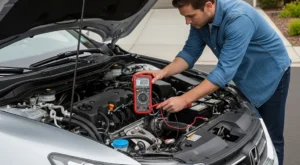
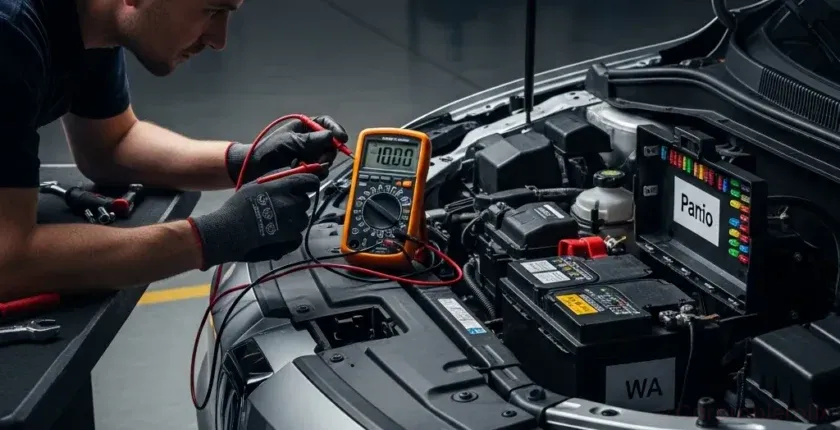
Step 3: Connect the Multimeter in Series
- Set your multimeter to the 10A DC current range.
- Turn the car off and remove the key/fob from the area.
- Loosen and remove the negative battery cable from the negative terminal.
- Connect the meter’s black lead to the negative battery post.
- Connect the meter’s red lead to the removed negative cable clamp.
You’ve now placed the meter in series between the battery and the vehicle. All current leaving the battery must pass through the meter, which allows you to measure the draw.
Step 4: Read and Interpret the Current Draw
Once connected:
- Initial reading may be high (0.5–2.0 A) as modules wake up from the disturbance.
- Wait again 10–20 minutes for the system to return to sleep.
- Watch the reading; it should gradually drop to its resting level.
What you want to see:
- 0.02–0.05 A (20–50 mA): Normal for most vehicles.
- 0.05–0.10 A (50–100 mA): Mildly high; may be acceptable on some cars but worth investigating.
- 0.10 A (100 mA) or more: Significant parasitic drain that can kill a battery in a day or two.
Isolating the Problem Circuit: The Fuse-Pull Method
Once you confirm an excessive draw, the next step is to figure out which circuit is responsible. The most practical DIY method is to pull fuses one by one while watching the meter.
Step 5: Locate Fuse Boxes and Get a Diagram
- Most vehicles have at least two fuse boxes: one under the hood and one inside the cabin (often under the dash or behind a panel).
- Use your owner’s manual or a factory service manual to identify fuse locations and functions.
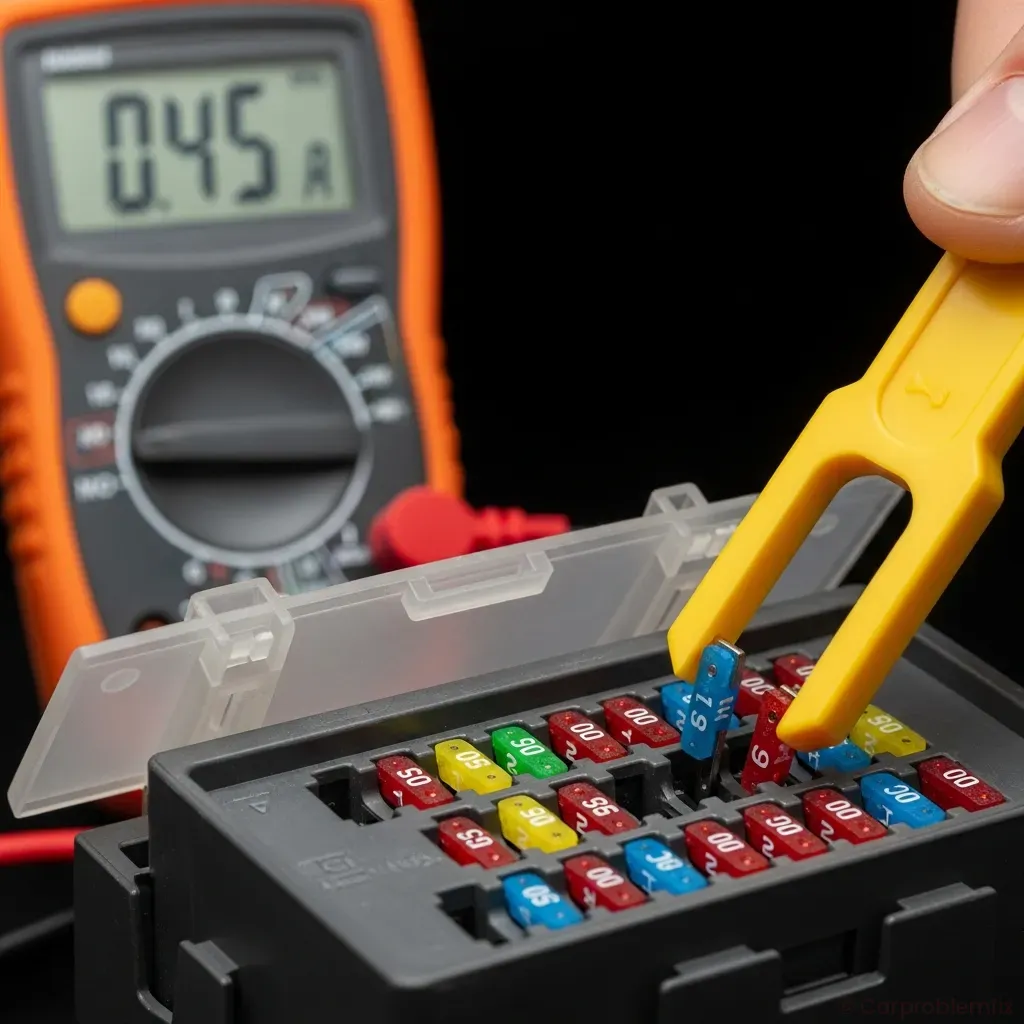
Step 6: Pull Fuses One at a Time
- With the meter still connected and reading a stable draw, start with one fuse box.
- Pull one fuse, note the change in current draw, then reinstall the fuse before moving to the next one.
- Watch the meter as you pull each fuse. When the draw suddenly drops to a normal level, you’ve found the circuit responsible.
For example, if your draw is 0.35 A and pulling the “INTERIOR LAMPS” fuse drops it to 0.03 A, the parasitic drain is on that circuit.
Step 7: Identify Components on the Problem Circuit
Once you know which fuse affects the draw, look up everything that fuse powers. Common examples:
- Interior lights, glove box, trunk light
- Radio, amplifier, navigation system
- Body control module (BCM)
- Door modules, power seats, mirrors
From here, you can disconnect individual components on that circuit one by one (unplug connectors, remove bulbs, etc.) while watching the meter, until the draw drops. That tells you which specific component is the culprit.
Special Cases and Advanced Checks
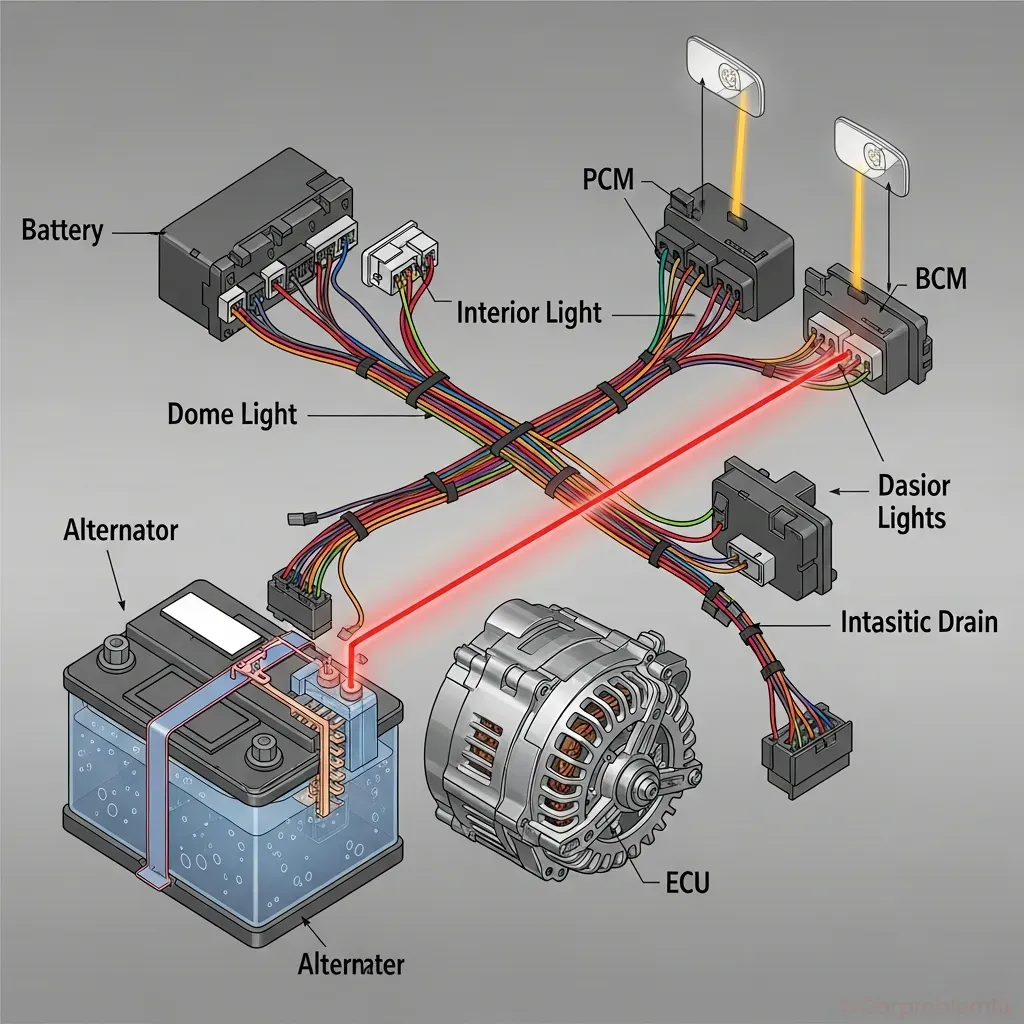
Checking for Alternator Diode Drain
If pulling fuses doesn’t change the draw, or if the alternator is on a main fusible link instead of a small fuse, you can test it directly:
- With the meter still in series on the negative cable, disconnect the alternator main output wire (usually a large cable on the back of the alternator, secured with a nut).
- If the current draw drops significantly when you disconnect the alternator, a bad diode is likely causing the drain.
Be sure to insulate the disconnected alternator cable so it can’t touch metal and short out.
Module Wake-Up and CAN Bus Issues
Modern vehicles use a communication network (CAN bus) that allows modules to talk to each other. A faulty sensor, sticky door switch, or bad module can keep waking up the network, causing intermittent spikes in current draw.
Signs include:
- Draw that cycles up and down instead of staying steady.
- Random clicking relays or faint buzzing noises after shutdown.
- Interior lights or dash lights flickering briefly with the key off.
These cases can be difficult to diagnose without a factory scan tool that can monitor module sleep states. If your draw is intermittent or you can’t pin it down with fuse-pulling, it may be time to involve a specialist.
Common Fixes for Parasitic Battery Drain
1. Replace or Adjust Faulty Switches
- Door-ajar switches: Replace switches that don’t reliably detect closed doors.
- Glove box/trunk switches: Adjust or replace if the light stays on with the lid closed.
- Hood switch: Can keep security systems or underhood lights active.
2. Repair or Rewire Aftermarket Add-Ons
- Rewire amps and accessories to ignition-switched power instead of constant 12V.
- Install a proper relay or use a fuse tap that turns off with the key.
- Remove low-quality alarm or remote start systems that never sleep properly.
3. Replace Stuck Relays and Faulty Modules
- Cooling fan or blower relays that stay energized should be replaced.
- If a specific module is confirmed to be staying awake (e.g., radio, BCM), replacement or reprogramming may be required.
Because modules are expensive and often require programming, confirm diagnosis carefully before replacing.
4. Fix Alternator or Wiring Faults
- Replace alternators with bad diodes; rebuilding is possible but less common for DIYers.
- Repair corroded connectors and damaged wiring harnesses that cause unintended power feeds.
When to See a Professional
Parasitic drain diagnosis can be straightforward, but some situations call for a professional shop:
- Intermittent drains: The car only dies once every week or two, and your meter readings vary wildly.
- Complex CAN bus issues: Suspected module wake-up problems or network faults.
- Luxury or high-end vehicles: Multiple fuse boxes, dozens of modules, and sensitive electronics.
- Evidence of major wiring damage: Rodent-chewed harnesses, flood damage, or previous hack repairs.
A good electrical specialist will use tools like clamp-on ammeters, factory scan tools, and wiring diagrams to track down complex drains more efficiently than most DIYers can.
Preventing Future Parasitic Drain Problems
- Be cautious with aftermarket installs: Use proper wiring practices, relays, and ignition-switched power sources.
- Address warning signs early: Flickering lights, random chimes, and intermittent accessory issues can be early clues.
- Maintain battery and charging system: A weak battery or alternator can mask or worsen parasitic drain issues.
- Drive regularly: Short trips and long sitting periods are hard on batteries even without parasitic drains.
If you ever notice other symptoms alongside your electrical issues—like a low oil pressure warning at idle or a steering wheel that shakes when braking—treat them as separate problems that deserve their own diagnosis. Electrical issues often show up alongside mechanical ones simply because modern cars are so interconnected.
Key Takeaways
- Normal key-off draw is typically 20–50 mA; anything consistently above 80–100 mA is suspect.
- Most parasitic drains come from lights left on, aftermarket equipment, stuck relays, or modules that won’t sleep.
- A basic multimeter and patience are enough to diagnose many drains using the series current test and fuse-pull method.
- Alternator diode failures can cause drains even if charging seems normal while driving.
- For intermittent or network-related issues, a professional with factory-level tools is often the fastest, least-frustrating option.
By methodically measuring current draw and isolating circuits, you can track down most parasitic battery drains at home and stop the cycle of dead batteries before it leaves you stranded again.