
- 1. Why CVT Transmission Problems Are Different (and Easy to Misdiagnose)
- 2. Common CVT Symptoms You Should Never Ignore
- 2.1. 1. CVT Shudder or Judder on Takeoff
- 2.2. 2. Droning or Whining Noise That Changes With Speed
- 2.3. 3. Hesitation, Sluggish Takeoff, or Rubber-Band Feel
- 3. Top Causes of CVT Shudder, Drone & Hesitation
- 3.1. 1. Degraded or Incorrect CVT Fluid
- 3.2. 2. Belt or Chain and Pulley Wear
- 3.3. 3. Failing Valve Body or Pressure Control Solenoids
- 3.4. 4. Torque Converter Problems
- 3.5. 5. Software/TCM Calibration Issues
- 3.6. 6. External Issues That Mimic CVT Problems
- 4. DIY Diagnosis: How to Narrow Down CVT Problems at Home
- 4.1. 1. Check for Warning Lights and Stored Codes
- 4.2. 2. Inspect CVT Fluid Level and Condition
- 4.3. 3. Road Test: How to Reproduce the Symptoms
- 4.4. 4. Rule Out Engine and Mount Issues
- 5. Professional Diagnosis: What a Good Shop Should Do
- 6. Fixes for CVT Shudder, Drone & Hesitation
- 6.1. 1. CVT Fluid Change or Service
- 6.2. 2. Software Updates and Adaptation Resets
- 6.3. 3. Valve Body or Solenoid Repair
- 6.4. 4. Torque Converter Replacement
- 6.5. 5. Full CVT Rebuild or Replacement
- 7. How to Prevent CVT Problems in the First Place
- 7.1. 1. Follow (or Improve On) the Fluid Service Interval
- 7.2. 2. Avoid Overheating and Abuse
- 7.3. 3. Keep the Rest of the Car in Shape
- 8. When Is It Safe to Keep Driving With CVT Symptoms?
- 9. Key Takeaways
Why CVT Transmission Problems Are Different (and Easy to Misdiagnose)

Continuously Variable Transmissions (CVTs) are now common in Nissan, Subaru, Toyota, Honda, Mitsubishi, and many other brands. They feel smooth when healthy, but when things go wrong, drivers often describe vague symptoms: shudder, droning, rubber-band acceleration, or a delay when taking off from a stop.
Because CVTs don’t shift gears like a traditional automatic, many owners and even some generalist shops misdiagnose early warning signs. That can turn a minor fluid or software issue into full-blown belt and pulley damage costing thousands.

This guide focuses specifically on CVT shudder, droning noise, and hesitation—what causes them, how to diagnose them correctly, and which fixes actually work.
Common CVT Symptoms You Should Never Ignore
Before diving into causes, match what you’re feeling and hearing to the most common CVT complaints.
1. CVT Shudder or Judder on Takeoff
This is one of the classic early signs of CVT trouble. It can feel like:
- A vibration or “rumble strip” sensation between about 10–40 mph
- Shaking when gently accelerating from a stop or low speed
- Momentary loss of power followed by a surge
Drivers often think it’s an engine misfire or bad motor mount, but in many cases it’s the CVT’s belt or chain slipping slightly on the pulleys or the torque converter locking up poorly.
2. Droning or Whining Noise That Changes With Speed
Common descriptions include:
- “Loud humming” that rises and falls with road speed
- High-pitched whine under acceleration
- Low-frequency drone at steady highway speeds
Some noise is normal for many CVTs, but new or suddenly louder sounds, especially combined with shudder or hesitation, usually mean wear in the belt, pulleys, or bearings—or fluid that’s broken down.
3. Hesitation, Sluggish Takeoff, or Rubber-Band Feel
CVTs are designed to keep the engine in its power band, but when something’s wrong you may notice:
- Delay between pressing the gas and actual acceleration
- Engine revs climbing while the car barely speeds up
- Surging or hunting for the right ratio at light throttle
This can be a software/logic issue, a failing valve body, or mechanical wear inside the transmission.
Top Causes of CVT Shudder, Drone & Hesitation
Most CVT complaints fall into a few major categories. Understanding them helps you avoid expensive guesswork.
1. Degraded or Incorrect CVT Fluid
CVTs are extremely sensitive to fluid condition and type. Unlike a conventional automatic, the fluid not only lubricates but also provides the precise friction characteristics that allow the belt or chain to grip the pulleys correctly.
When CVT fluid is old, overheated, or contaminated, you may see:
- Shudder on takeoff or light acceleration
- Whining or droning noise
- Hesitation or flare in engine RPM
Using the wrong fluid (for example, generic ATF instead of the manufacturer’s specified CVT fluid) can quickly damage the belt, pulleys, and valve body.
2. Belt or Chain and Pulley Wear
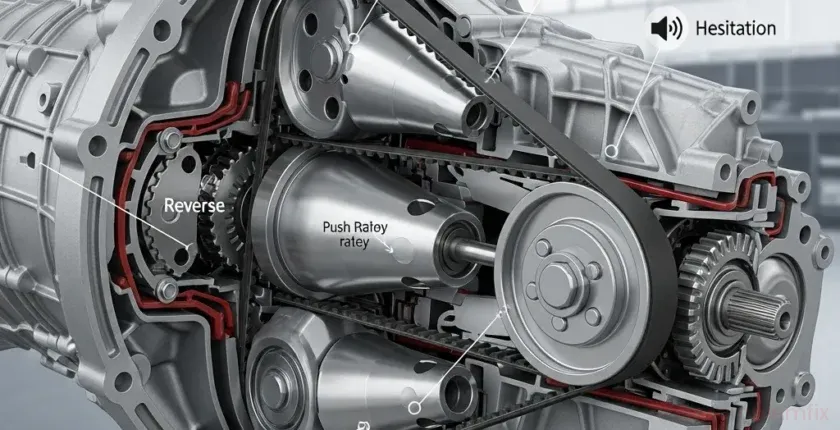
Inside most CVTs is a metal belt or chain running between two variable-diameter pulleys. Over time, especially with poor maintenance or heavy loads, these components can wear or glaze.
Symptoms of internal wear include:
- Persistent shudder that doesn’t improve with fluid changes
- Metallic whining or grinding noises
- Intermittent loss of drive, especially when hot
Once the belt or pulleys are physically worn, there is no additive or fluid that can permanently fix it—internal repair or replacement is usually required.
3. Failing Valve Body or Pressure Control Solenoids
The valve body in a CVT controls hydraulic pressure to the pulleys and clutches. Sticking valves, worn bores, or weak solenoids can cause:
- Delayed engagement when shifting from Park to Drive or Reverse
- Hesitation or jerky response at low speeds
- Intermittent limp mode with warning lights
Sometimes this is triggered by dirty fluid; in other cases, the valve body itself is worn and needs repair or replacement.
4. Torque Converter Problems
Many CVTs still use a torque converter between the engine and transmission. A failing torque converter clutch can mimic engine misfires or CVT belt slip:
- Shudder at specific speeds (often 25–45 mph)
- Vibration that comes and goes with light throttle
- RPM fluctuations at steady speeds
Because the symptoms overlap with engine and ignition issues, proper diagnosis is critical before condemning the transmission.
5. Software/TCM Calibration Issues
Many manufacturers have released updated software for their CVT Transmission Control Modules (TCMs) to address:
- Hesitation or delay when accelerating from a stop
- Harsh engagement into Drive or Reverse
- Unnecessary high RPM during light acceleration
In some cases, a simple TCM reflash or adaptation reset can dramatically improve driveability, especially on newer vehicles.
6. External Issues That Mimic CVT Problems
Not every shudder or drone is the transmission. Common imposters include:
- Engine misfires (coil, plug, injector issues)
- Worn engine or transmission mounts
- Wheel bearing hum that changes with steering input
- Exhaust drone from leaks or aftermarket systems
Ruling these out first can save you from an unnecessary transmission replacement.
DIY Diagnosis: How to Narrow Down CVT Problems at Home
You don’t need a lift or a full shop to get meaningful clues about your CVT’s health. Follow these steps before authorizing expensive work.
1. Check for Warning Lights and Stored Codes
Even if the Check Engine or transmission warning light is off, there may be stored or pending codes. Use a decent OBD2 scanner (ideally one that can access the transmission module) and look for:
- CVT temperature codes
- Pressure control or ratio monitoring codes
- Torque converter clutch performance codes
Write down any codes before clearing them. Codes related to CVT ratio or pressure often point toward internal wear or valve body issues.
2. Inspect CVT Fluid Level and Condition
Many modern CVTs don’t have a traditional dipstick, but if yours does:
- Warm the car up and park on level ground.
- With the engine idling, cycle through all gears, then leave it in Park.
- Check the fluid level and color on the dipstick.
Healthy CVT fluid is usually clear to light amber with a mild odor. Warning signs include:
- Dark brown or black fluid
- Burnt smell
- Glittery or metallic particles
If there’s no dipstick, many CVTs use a fill/level plug on the side of the case. Accessing it safely is usually a job for a shop, but you can still look for leaks around the pan and cooler lines.
3. Road Test: How to Reproduce the Symptoms
When test-driving, be methodical:
- From a stop: Gently accelerate and feel for shudder between 5–30 mph.
- Light throttle cruise: Hold a steady speed around 25–45 mph and note any vibration or RPM fluctuation.
- Highway speeds: Listen for droning or whining that changes with speed but not engine RPM.
Try the same maneuvers with the A/C off and then on. If you notice strange behavior when the A/C cycles, you may also want to read about AC performance issues, since extra load from the compressor can exaggerate marginal CVT problems.
4. Rule Out Engine and Mount Issues
Before blaming the CVT, do these quick checks:
- Listen for misfires or rough idle in Park and Neutral.
- With the hood open, lightly power-brake (foot firmly on brake, gently apply throttle) and watch for excessive engine movement—this can indicate bad mounts.
- Note whether the vibration is present in Neutral at the same RPM; if it is, the issue may be engine-related, not CVT.
Professional Diagnosis: What a Good Shop Should Do

If your DIY checks point toward the CVT, a competent transmission shop or dealer should:
- Scan all modules for codes, not just the engine
- Check CVT fluid level and condition using the manufacturer’s procedure
- Monitor live data: CVT ratio, line pressure, temperature, and slip
- Perform a controlled road test with a scan tool connected
- Check for TSBs (Technical Service Bulletins) and software updates
Be wary of any shop that jumps straight to “you need a new transmission” without documenting codes, fluid condition, and test results.
Fixes for CVT Shudder, Drone & Hesitation
The right repair depends on how far the problem has progressed. Catching issues early can mean the difference between a few hundred dollars and several thousand.
1. CVT Fluid Change or Service
If the fluid is old but not burnt or full of metal, a proper CVT fluid service is often the first step.
- Always use the exact fluid specified by the manufacturer.
- On high-mileage units, a series of drain-and-fills is often safer than a power flush.
- Some CVTs have an internal filter or screen that can be replaced; others are non-serviceable.
Many owners report a noticeable reduction in shudder and noise after a correct fluid service, especially if it’s the first one the car has ever had.
2. Software Updates and Adaptation Resets
If your vehicle has known TCM updates, a dealer or qualified shop can:
- Reflash the TCM with updated logic
- Reset learned adaptations
- Perform a drive cycle to re-teach the CVT shift behavior
This is especially effective for hesitation and odd ratio behavior without any mechanical noise or harshness.
3. Valve Body or Solenoid Repair
When codes and symptoms point to pressure control issues, the valve body may be the culprit. Options include:
- Replacing individual solenoids (if available separately)
- Installing a remanufactured valve body
- In some cases, updating both valve body and TCM together
This is often cheaper than a full transmission replacement and can restore normal operation if the belt and pulleys are still healthy.
4. Torque Converter Replacement
If shudder occurs only in a narrow speed range and is linked to torque converter clutch engagement, replacing the torque converter may be recommended. Because the transmission must be removed to access it, many shops will:
- Inspect the CVT for internal wear at the same time
- Recommend replacement if significant metal is found
5. Full CVT Rebuild or Replacement
When there is significant internal wear, metal contamination, or repeated failure after fluid and valve body work, the remaining option is major repair:
- Remanufactured CVT: Often the best balance of cost and reliability, with updated parts.
- Used/junkyard CVT: Cheaper upfront but risky unless mileage and history are known.
- Dealer new unit: Usually the most expensive but may come with the longest warranty.
On some models—especially older compact SUVs and sedans—it’s worth comparing the cost of a CVT replacement to the vehicle’s overall value. If you own something like a high-mileage compact crossover, you might also look into long-term reliability trends (for example, our Toyota RAV4 reliability by year guide) before investing heavily.
How to Prevent CVT Problems in the First Place
CVTs can be reliable if treated correctly. The key is preventive care and realistic expectations.
1. Follow (or Improve On) the Fluid Service Interval
Many manufacturers originally claimed “lifetime” CVT fluid, but real-world experience shows that’s optimistic. A safer rule of thumb:
- Normal driving: Change CVT fluid every 40,000–60,000 miles.
- Severe service (towing, mountains, hot climate, lots of stop-and-go): Every 30,000–40,000 miles.
Keep receipts and documentation—this can help with goodwill assistance if the transmission fails just out of warranty.
2. Avoid Overheating and Abuse
CVTs don’t like:
- Extended full-throttle acceleration
- Heavy towing beyond rated capacity
- Holding high speeds up long grades in hot weather
If you live in a mountainous or very hot area, consider adding an auxiliary transmission cooler (if compatible with your model) and be gentle when climbing long hills.
3. Keep the Rest of the Car in Shape
Problems elsewhere can stress the CVT:
- Misfires and poor engine tune force the CVT to work harder to maintain speed.
- Dragging brakes or seized calipers increase load; regular brake maintenance helps.
- Underinflated tires increase rolling resistance and heat.
When Is It Safe to Keep Driving With CVT Symptoms?
Some mild CVT quirks are more annoying than dangerous, but others are early signs of imminent failure. Use this as a rough guide:
- Probably safe short-term: Mild drone or whine that’s been stable for years, no warning lights, no shudder, normal engagement.
- Get it checked soon: New shudder on takeoff, intermittent hesitation, or fluid that looks dark but not burnt.
- Stop driving and tow: Loud grinding, slipping under light throttle, burning smell, or metal-filled fluid.
Continuing to drive a CVT that’s slipping or overheating can quickly turn a borderline repairable unit into a complete write-off.
Key Takeaways
- CVT shudder, drone, and hesitation are often early warnings—not something to ignore.
- Degraded or incorrect fluid is the most common and most fixable cause, but only if caught early.
- Proper diagnosis should include scanning for codes, checking fluid, and ruling out engine, mount, and wheel bearing issues.
- Software updates, valve body repair, and torque converter replacement can solve many issues without a full transmission swap.
- Regular fluid service, gentle driving under load, and overall vehicle maintenance dramatically extend CVT life.
If you’re already experiencing CVT symptoms, document them carefully, gather scan data if possible, and get a second opinion from a shop that specializes in transmissions—before you authorize a costly replacement that might not be your only option.