Does your car feel perfectly fine around town, but once you hit 60–75 mph the steering wheel, seat, or even the whole car starts to shake? That specific “only at highway speeds” vibration is more than just annoying – it’s your car telling you something is wrong.
- 1. Why Vibration Only Shows Up at Highway Speeds
- 2. Main Types of Highway-Speed Vibration
- 3. Most Common Causes of Vibration at Highway Speeds
- 3.1. 1. Wheel and Tire Imbalance
- 3.2. 2. Tire Problems: Cupping, Broken Belts, and Out-of-Round Tires
- 3.3. 3. Wheel Alignment and Suspension Wear
- 3.4. 4. Warped Brake Rotors (High-Speed, Light-Brake Vibration)
- 3.5. 5. Worn CV Axles (Front-Wheel Drive and Many AWD Vehicles)
- 3.6. 6. Driveshaft and U-Joint Problems (RWD, 4WD, and Some AWD)
- 3.7. 7. Engine and Transmission Mount Issues
- 3.8. 8. Wheel Bearing Problems
- 4. Step-by-Step DIY Diagnosis: Narrowing Down the Cause
- 4.1. Step 1: Note When the Vibration Happens
- 4.2. Step 2: Identify Where You Feel It
- 4.3. Step 3: Inspect Tires and Wheels
- 4.4. Step 4: Check Suspension and Steering Play
- 4.5. Step 5: Road-Test After Each Change
- 5. Is It Safe to Drive With Highway-Speed Vibration?
- 6. Preventing Future Highway-Speed Vibrations
- 7. When to See a Professional Mechanic
- 8. Key Takeaways
This guide breaks down why your car vibrates only at higher speeds, how to pinpoint the cause, what you can safely check yourself, and when it’s time to see a professional before minor issues turn into expensive repairs.
Why Vibration Only Shows Up at Highway Speeds
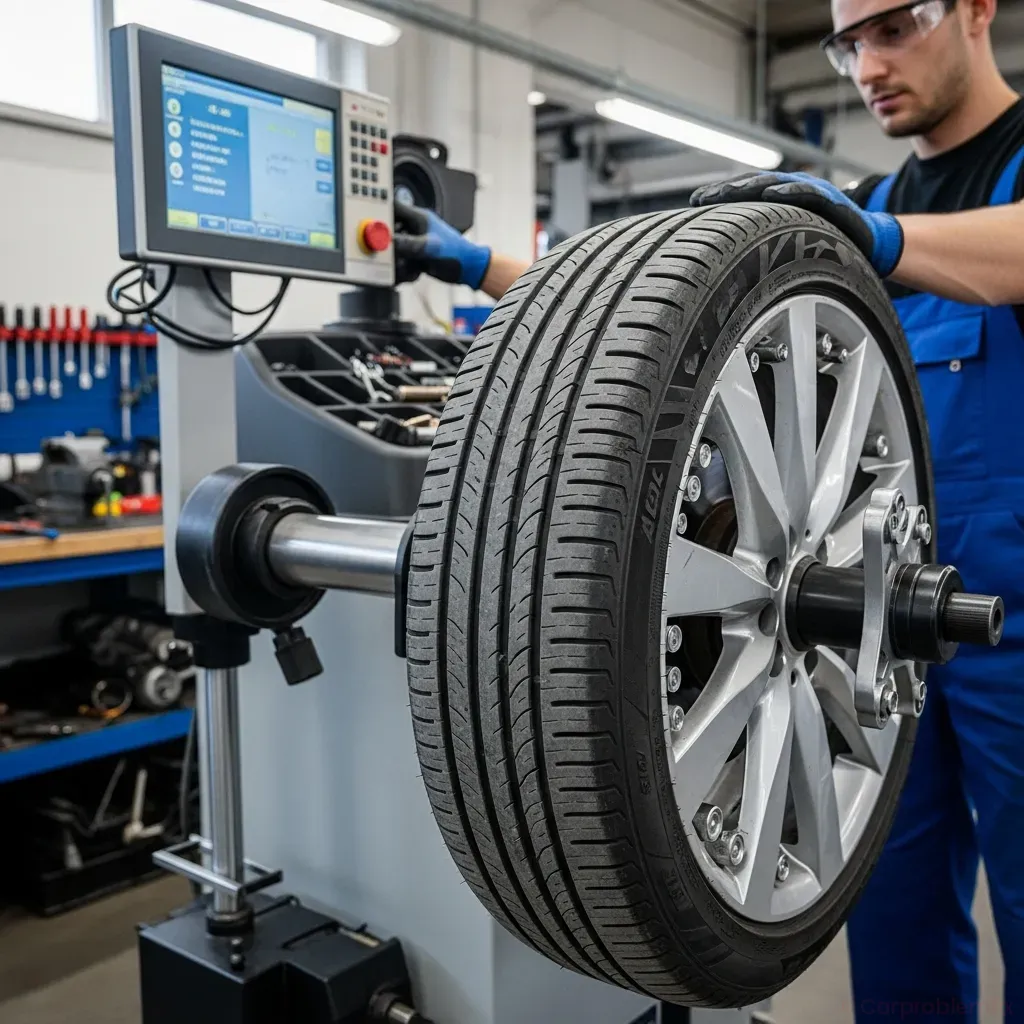

Vibrations that appear only at higher speeds are almost always related to rotating parts: wheels, tires, axles, driveshafts, or engine/transmission components under heavier load. At low speeds, small imbalances or defects don’t create enough force to be noticeable. As speed increases, those small issues multiply into a noticeable shake.
Think of it like a washing machine: slightly unbalanced at slow spin is fine; at high spin it starts walking across the floor. Your car behaves the same way when something is out of balance or out of alignment.
Main Types of Highway-Speed Vibration
Before chasing causes, pay attention to where you feel the vibration. That gives big clues:
- Steering wheel shakes at 55–75 mph → often front wheels/tires, front brakes, or steering/suspension components.
- Seat or floor vibrates more than steering wheel → often rear wheels/tires, driveshaft (RWD/4WD), or rear suspension.
- Whole car buzzes at a specific speed range → tire balance, tire defects, or drivetrain imbalance.
- Vibration only under acceleration, then smooths when coasting → engine/transmission mounts, inner CV joints, or driveshaft angles.
Most Common Causes of Vibration at Highway Speeds
1. Wheel and Tire Imbalance
Imbalance is the single most common cause of highway-speed vibration. If a wheel/tire assembly is heavier in one spot, centrifugal force at speed makes it wobble.
Typical symptoms:
- Vibration starts around 55–65 mph and may get worse with speed.
- Steering wheel shimmy if front wheels are affected.
- Vibration felt through seat if rear wheels are affected.
Common causes of imbalance:
- Wheel weights fell off after a pothole or car wash.
- New tires not balanced correctly.
- Bent wheel from hitting a curb or pothole.
- Uneven tire wear or flat spots (from sitting parked too long or emergency braking).
DIY checks:
- Visually inspect wheels for missing weights (small metal or stick-on pieces on the rim).
- Look for obvious bends, cracks, or dents on the rim lip.
- Run your hand gently over the tire tread (engine off, car in Park, parking brake set) to feel for high/low spots or cupping.
Fix: Have all four wheels spin-balanced by a shop. Ask for road-force balancing if the vibration is stubborn; it simulates load and can identify bad tires or slightly bent wheels that standard balancing misses.
2. Tire Problems: Cupping, Broken Belts, and Out-of-Round Tires
Even if your tires are balanced, structural problems can cause vibration that shows up only at speed.
Common tire-related issues:
- Cupped or scalloped tread – alternating high and low spots around the tire, often from worn shocks/struts or poor alignment.
- Broken or shifted belt – internal steel belts move or break, making the tire egg-shaped or lumpy.
- Out-of-round tire – manufacturing defect or damage from potholes/impacts.
Symptoms:
- Vibration at a specific speed range that doesn’t change much with road surface.
- Humming or droning noise that changes with speed.
- Visible high spots, bulges, or waves in the tread or sidewall when the wheel spins.
DIY checks:
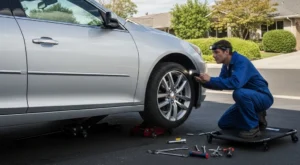
- Jack up the car safely and spin each wheel by hand.
- Watch the tread and sidewall from the front and side – look for wobble or up-and-down movement.
- Check for sidewall bubbles or bulges (replace immediately if found).
Fix: Replace any tire with broken belts, major out-of-round, or sidewall damage. Cupped tires may quiet down slightly after suspension repairs and rotation, but severe cupping usually requires replacement.
3. Wheel Alignment and Suspension Wear
Misalignment by itself usually causes pulling and uneven tire wear more than vibration. But when combined with worn suspension parts, it can create a shake at higher speeds.
Key components that contribute to vibration when worn:
- Tie rod ends
- Ball joints
- Control arm bushings
- Struts and shocks
Symptoms:
- Vibration plus wandering or “loose” steering at highway speeds.
- Uneven tire wear (inner or outer edges worn more).
- Clunk or knock over bumps, or when turning the steering wheel at low speeds.
If you also hear noise while turning the wheel at low speeds, see our detailed guide on car makes noise when turning the steering wheel for steering-specific diagnosis.
DIY checks:
- With the car safely lifted, grab each front wheel at 3 and 9 o’clock and wiggle – play here can indicate tie rod or steering issues.
- Grab at 12 and 6 o’clock – play can indicate ball joint or wheel bearing issues.
- Look for leaking shocks/struts and broken or cracked bushings.
Fix: Replace worn suspension/steering parts, then get a four-wheel alignment. Don’t align a car with obviously worn components – the alignment won’t hold and vibration will return.
4. Warped Brake Rotors (High-Speed, Light-Brake Vibration)
Severely warped rotors usually cause vibration while braking, but mild rotor issues can sometimes be felt as a slight shimmy at highway speeds even when you’re not on the brakes.
Symptoms:
- Steering wheel shakes when braking from highway speeds.
- Pulsation felt in the brake pedal.
- Vibration worse on long downhill braking.
DIY checks:
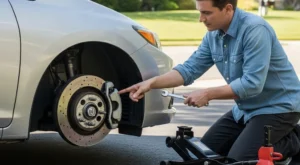
- Visually inspect rotors through the wheel spokes – look for heavy grooves, blue spots, or obvious thickness variation.
- Note whether vibration is much worse when braking – if yes, rotors are strong suspects.
Fix: Replace rotors and pads in axle pairs (both fronts or both rears). Machining rotors is less common now; many shops simply replace them due to cost and thickness limits.
5. Worn CV Axles (Front-Wheel Drive and Many AWD Vehicles)
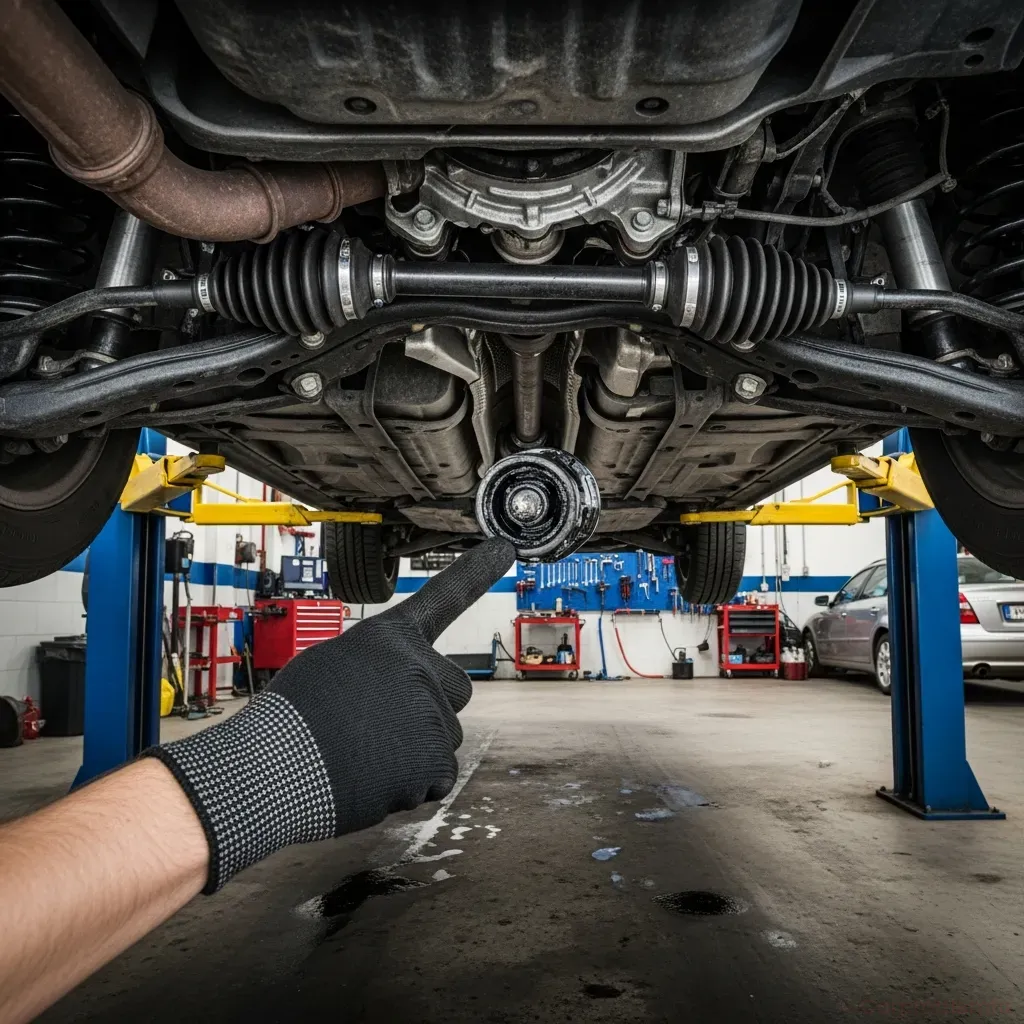
Constant velocity (CV) axles transfer power to the wheels while allowing steering and suspension movement. When inner CV joints wear, they can cause vibration that shows up mainly under acceleration at higher speeds.
Symptoms:
- Vibration under load (accelerating at 50–70 mph) that smooths out when you let off the gas.
- Shuddering when accelerating up hills.
- Clicking noise on turns (more common with outer CV joint wear).
- Grease splattered around the inside of the wheel or undercarriage from torn CV boots.
DIY checks:
- Inspect CV boots for tears, splits, or missing clamps.
- With the car safely lifted, rotate the axle by hand and feel for roughness or excessive play.
Fix: Replace the affected CV axle(s). In most cases, replacing the entire axle assembly is more reliable than trying to rebuild individual joints.
6. Driveshaft and U-Joint Problems (RWD, 4WD, and Some AWD)
On vehicles with a driveshaft, any imbalance or worn U-joints can cause a deep, rhythmic vibration that gets worse with speed.
Symptoms:
- Vibration felt through the seat or floor more than the steering wheel.
- Vibration increases with speed regardless of engine RPM or gear.
- Clunk when shifting from Park to Drive or when taking off.
- Whirring or droning noise from under the vehicle.
DIY checks:
- With the vehicle safely supported, inspect the driveshaft for missing balance weights or dents.
- Check U-joints by trying to twist the driveshaft by hand – there should be no noticeable play.
- Look for rust-colored dust around U-joints, indicating wear.
Fix: Replace worn U-joints and have the driveshaft inspected and rebalanced if needed. Severe dents or bends usually require driveshaft replacement.
7. Engine and Transmission Mount Issues
Worn or broken mounts allow the engine and transmission to move excessively. At highway speeds or under load, that movement can translate into vibration felt through the cabin.
Symptoms:
- Vibration mainly under acceleration or at certain RPMs.
- Clunk or thump when shifting from Park to Drive/Reverse.
- Excessive engine movement when revving in Park/Neutral.
DIY checks:
- With the hood open and parking brake set, have a helper shift from Park to Drive/Reverse while you watch the engine (stay clear of moving parts). Large movement indicates mount issues.
- Look for cracked rubber or separated mount components.
Fix: Replace the failed mount(s). Often, replacing one obviously bad mount reveals weakness in others, so a full set may be recommended on high-mileage vehicles.
8. Wheel Bearing Problems
Wheel bearings more often cause noise (humming, growling) than vibration, but advanced wear can create a shake at highway speeds.
Symptoms:
- Growling or humming noise that gets louder with speed.
- Noise changes when turning slightly left or right at highway speeds.
- In severe cases, vibration through the steering wheel or body.
DIY checks:
- With the car lifted, spin each wheel by hand and listen for grinding or roughness.
- Check for play by rocking the wheel at 12 and 6 o’clock.
Fix: Replace the affected wheel bearing or hub assembly. Don’t delay – a failed bearing can cause wheel lockup or separation.
Step-by-Step DIY Diagnosis: Narrowing Down the Cause
You don’t need a shop full of tools to get a good idea of what’s causing your highway-speed vibration. Use this logical sequence:
Step 1: Note When the Vibration Happens
- Only at a certain speed range (e.g., 60–70 mph) → likely wheel/tire balance or tire defects.
- Worse when accelerating, better when coasting → CV axles, engine/trans mounts, or driveshaft.
- Worse when braking at highway speeds → warped rotors or brake issues.
- Changes with steering input (slight left/right) → wheel bearings or tire issues.
Step 2: Identify Where You Feel It
- Steering wheel → front wheels/tires, front suspension, front brakes.
- Seat/floor → rear wheels/tires, driveshaft, rear suspension.
- Whole body → severe imbalance, multiple tires, or drivetrain.
Step 3: Inspect Tires and Wheels
- Check tire pressures (set to door-jamb spec, not sidewall max).
- Look for uneven wear, cupping, bulges, or sidewall damage.
- Inspect wheels for bends, cracks, or missing weights.
Step 4: Check Suspension and Steering Play
- Lift the car safely and check for wheel play at 3/9 and 12/6 positions.
- Look for leaking shocks/struts and torn bushings.
Step 5: Road-Test After Each Change
Start with the simplest, most common fixes:
- Rotate tires front-to-rear and test drive – does the vibration move from steering wheel to seat or vice versa? That points to a specific pair of tires/wheels.
- Have all four wheels balanced – many vibrations are solved right here.
- If still present, move on to more in-depth suspension, brake, and drivetrain checks.
Is It Safe to Drive With Highway-Speed Vibration?
A mild vibration that just started and is clearly related to a recent tire change or wheel hit might not be an immediate emergency, but you should still address it quickly. In some cases, vibration is a warning of something more serious:
- Unsafe – stop driving and inspect immediately if:
- Vibration is violent or feels like the car is hopping.
- You see a tire bulge, sidewall cut, or exposed cords.
- There is loud grinding or growling from a wheel.
- The steering feels like it might “let go” or suddenly change direction.
- Urgent – schedule service soon if:
- Vibration is moderate and consistent at highway speeds.
- You suspect worn suspension or steering parts.
- There’s noticeable play in wheels or clunks when shifting.
- Monitor briefly – but still fix:
- Minor shimmy after new tires or wheel repairs (likely balance-related).
- Vibration that starts only above 75 mph and is very mild – but note this is still wearing tires and components faster.
Preventing Future Highway-Speed Vibrations
Once you’ve fixed the current problem, a few habits will help keep your car smooth on the highway:
- Balance tires every time you install new ones or rotate them if you notice any new vibration.
- Rotate tires regularly (typically every 5,000–7,500 miles) to prevent uneven wear and cupping.
- Avoid potholes and slow down for rough roads to protect wheels, tires, and suspension.
- Get an alignment whenever you replace major suspension parts or notice uneven tire wear.
- Inspect suspension annually, especially on higher-mileage vehicles.
When to See a Professional Mechanic
If you’ve checked tire pressures, visually inspected the tires and wheels, and maybe even had a balance done but the vibration persists, it’s time for a professional diagnosis. A good shop can:
- Use road-force balancing to identify subtle tire or wheel defects.
- Measure rotor runout and thickness variation accurately.
- Check driveshaft angles, U-joint play, and CV axle condition.
- Perform a full suspension and steering inspection on a lift.
If you’re also shopping for a newer, more stable family vehicle because your current one is becoming a money pit, our guide on how to choose a safe, reliable family car in 2025 can help you avoid inheriting someone else’s vibration and suspension problems.
Key Takeaways
- Highway-speed vibration is almost always related to rotating parts – start with wheels and tires.
- Where you feel the vibration (steering wheel vs. seat vs. whole body) is a major diagnostic clue.
- Tire balance and tire defects are the most common and easiest-to-fix causes.
- Ignoring vibration accelerates wear on tires, suspension, and drivetrain components – and can become a safety issue.
- If basic checks and balancing don’t solve it, have a professional inspect suspension, brakes, and drivetrain.
Addressing highway-speed vibration early keeps your car safer, more comfortable, and cheaper to maintain in the long run.