- 1. What Is OBD2 Code P0300?
- 2. Why P0300 Matters and How Serious It Is
- 3. Common Symptoms of Code P0300
- 4. Top Causes of OBD2 Code P0300
- 4.1. 1. Ignition System Problems
- 4.2. 2. Fuel Delivery Issues
- 4.3. 3. Air and Vacuum Problems
- 4.4. 4. Engine Mechanical Problems
- 4.5. 5. Sensor and Control System Problems
- 5. How to Diagnose OBD2 Code P0300
- 5.1. Step 1: Confirm the Code and Check for Others
- 5.2. Step 2: Look at Live Data (If Available)
- 5.3. Step 3: Perform a Visual Inspection
- 5.4. Step 4: Check Ignition Components
- 5.5. Step 5: Check for Vacuum Leaks
- 5.6. Step 6: Test Fuel Delivery
- 5.7. Step 7: Check Engine Mechanical Condition
- 6. How to Fix OBD2 Code P0300
- 6.1. 1. Replace Spark Plugs
- 6.2. 2. Replace Ignition Coils or Wires
- 6.3. 3. Fix Vacuum Leaks
- 6.4. 4. Clean or Replace the MAF Sensor
- 6.5. 5. Address Fuel System Problems
- 6.6. 6. Repair Engine Mechanical Issues
- 7. Can You Drive With Code P0300?
- 8. Preventing P0300 in the Future
- 9. When to Seek Professional Help
- 10. Key Takeaways
What Is OBD2 Code P0300?
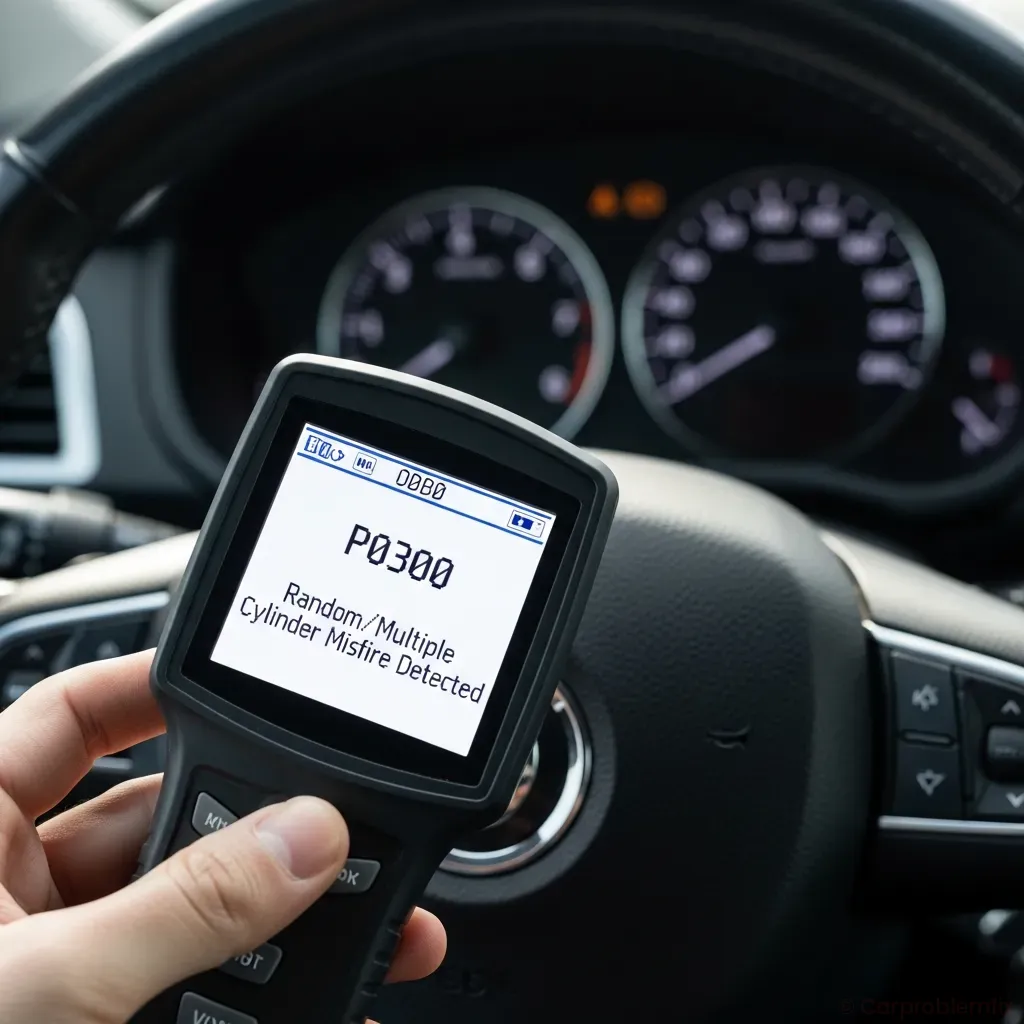
OBD2 code P0300 is one of the most common and confusing trouble codes you’ll see when the check engine light comes on. It stands for “Random/Multiple Cylinder Misfire Detected.” In plain English, your engine’s cylinders are misfiring, but not in a consistent pattern that the computer can tie to just one cylinder.
Unlike codes such as P0301, P0302, etc. (which point to a specific cylinder), P0300 tells you that misfires are happening across multiple cylinders or moving around from one cylinder to another. That makes diagnosis more challenging, but with a methodical approach you can track it down without throwing parts at the car.

Why P0300 Matters and How Serious It Is
A misfire means one or more cylinders are not burning the air-fuel mixture correctly. That can cause:
- Rough running, shaking, or vibration
- Poor acceleration and reduced power
- Increased fuel consumption
- Raw fuel entering the exhaust system
Raw fuel in the exhaust is especially dangerous for your catalytic converter. If you keep driving with a severe misfire, the converter can overheat and melt internally, leading to an expensive repair.
How serious P0300 is depends on the symptoms:
- Check engine light steady, mild roughness: You can usually drive short distances, but you should diagnose it soon.
- Check engine light flashing, engine shaking hard: This indicates an active, severe misfire that can quickly damage the catalytic converter. Avoid driving and address it immediately.
Common Symptoms of Code P0300
Most vehicles with P0300 will show one or more of these symptoms:
- Check engine light on (steady or flashing)
- Rough idle or shaking at stoplights
- Hesitation or stumbling when accelerating
- Loss of power, especially under load or on hills
- Exhaust smell of raw fuel or occasional popping
- Poor fuel economy
- In some cases, hard starting or extended cranking
Sometimes P0300 appears alongside other codes, such as specific cylinder misfire codes (P0301–P0308), fuel trim codes, or oxygen sensor codes. Those additional codes are valuable clues.
Top Causes of OBD2 Code P0300
Because P0300 is a “random” misfire, you need to think in terms of problems that can affect multiple cylinders at once. The most common causes fall into a few major categories.
1. Ignition System Problems
The ignition system is responsible for creating a strong spark at the right time. Weak or inconsistent spark is a leading cause of random misfires.
- Worn or fouled spark plugs: Old plugs with worn electrodes or heavy carbon buildup can misfire under load.
- Failing ignition coils or coil packs: A weak coil can cause intermittent misfires across the cylinders it feeds.
- Damaged plug wires or boots (on older designs): Cracks, burns, or internal breaks can cause arcing and misfires.
- Poor electrical grounds or connections: Corroded grounds can affect coil performance and timing signals.
2. Fuel Delivery Issues
If the engine isn’t getting the right amount of fuel, combustion becomes unstable and misfires occur.
- Weak fuel pump: Low fuel pressure can cause lean misfires, especially at higher RPM or under load.
- Clogged fuel filter: Restricts flow and mimics a weak pump.
- Dirty or failing fuel injectors: Poor spray pattern or stuck injectors can cause random misfires across cylinders.
- Bad fuel pressure regulator: Can cause both rich and lean conditions, depending on failure mode.
3. Air and Vacuum Problems
The engine needs a precise air-fuel mixture. Extra unmetered air or restricted airflow can upset that balance.
- Vacuum leaks: Cracked hoses, leaking intake manifold gaskets, or a faulty brake booster can all introduce unmetered air.
- Dirty or failing MAF (Mass Air Flow) sensor: Misreports incoming air, causing incorrect fueling.
- Stuck open EGR valve: Too much exhaust gas recirculation at the wrong time dilutes the mixture and causes misfires.
- PCV system leaks or failures: A stuck PCV valve can act like a vacuum leak.
4. Engine Mechanical Problems
When the engine itself is worn or out of time, combustion becomes unreliable.
- Low compression in multiple cylinders: Due to worn piston rings, burned valves, or head gasket issues.
- Timing chain or belt problems: Jumped timing can cause misfires across the engine.
- Camshaft or crankshaft sensor issues: Incorrect timing signals can cause random misfires.
If you also notice oil spots under the car or oil consumption, it’s worth reading up on oil leaks when parked, as low oil can accelerate internal engine wear and lead to misfire-related problems.
5. Sensor and Control System Problems
Modern engines rely on a network of sensors and the engine control module (ECM) to keep everything in sync.
- Faulty oxygen (O2) sensors: Can cause incorrect fuel trim adjustments.
- Bad coolant temperature sensor: Makes the ECM think the engine is colder or hotter than it is, skewing fuel delivery.
- ECM software glitches or internal faults: Rare, but possible, especially if other causes have been ruled out.
How to Diagnose OBD2 Code P0300
You don’t need a professional shop to start diagnosing P0300. A basic OBD2 scanner and some simple tools can take you a long way.
Step 1: Confirm the Code and Check for Others
Use an OBD2 scanner to pull codes. Note:
- Whether P0300 is the only code
- Any cylinder-specific misfire codes (P0301–P0308)
- Fuel trim codes (P0171, P0172, etc.)
- Sensor codes (MAF, O2, crank/cam sensor)
The combination of codes will guide your next steps. For example, P0300 plus P0171 (system too lean) strongly hints at a vacuum leak or fuel delivery issue.
Step 2: Look at Live Data (If Available)
If your scanner supports live data, monitor:
- Short-term and long-term fuel trims: High positive trims suggest a lean condition; high negative trims suggest rich.
- MAF readings: Compare to expected values for your engine size at idle and under load.
- Misfire counters: Some scanners show which cylinders are misfiring and how often.
This can quickly narrow the field from “anything” to a few likely systems.
Step 3: Perform a Visual Inspection
Open the hood and look for obvious problems:
- Loose or damaged ignition coils and connectors
- Cracked or oil-soaked spark plug wires (if equipped)
- Vacuum hoses that are cracked, disconnected, or collapsed
- Oil or coolant in spark plug wells
- Signs of arcing (white tracks) on coils or wires in low light
If you hear a rhythmic thumping or knocking that changes with speed, you may also want to investigate any thumping noise that speeds up with the car, as some driveline issues can be mistaken for engine misfires.
Step 4: Check Ignition Components
Ignition parts are wear items and a very common cause of P0300.
- Spark plugs: Remove and inspect. Look for heavy deposits, oil fouling, cracked insulators, or worn electrodes. Compare color across cylinders; one odd plug can point to a specific problem.
- Ignition coils: If you have individual coil-on-plug units and a misfire is more frequent on certain cylinders, swap coils between cylinders and see if the misfire follows.
- Plug wires (if equipped): Check resistance and flex them gently to see if misfires occur when moved.
Step 5: Check for Vacuum Leaks
Vacuum leaks can cause random misfires, especially at idle.
- Listen for hissing noises around the intake manifold and vacuum lines.
- Spray carb cleaner or brake cleaner around suspected areas while the engine idles; a momentary change in RPM indicates a leak.
- Inspect the PCV valve and hose, brake booster hose, and any small vacuum lines.
Be cautious with flammable sprays and avoid hot surfaces and ignition sources.
Step 6: Test Fuel Delivery
If ignition and vacuum check out, move to the fuel system.
- Fuel pressure test: Use a fuel pressure gauge on the rail to verify pressure at idle and under load.
- Injector operation: Listen with a mechanic’s stethoscope or long screwdriver; each injector should make a consistent clicking sound.
- Fuel quality: Contaminated fuel or water in the tank can cause random misfires. Consider when you last filled up and any symptoms that started immediately afterward.
Step 7: Check Engine Mechanical Condition
If the basics are good, it’s time to verify the health of the engine itself.
- Compression test: Check all cylinders and compare readings. Low compression in multiple cylinders can cause P0300.
- Leak-down test: Helps pinpoint whether compression loss is through valves, rings, or head gasket.
- Timing verification: If you suspect a jumped timing belt or chain, inspect timing marks according to the service manual.
How to Fix OBD2 Code P0300

The right fix depends entirely on what your diagnosis reveals. Here are the most common repairs that resolve P0300, along with typical cost ranges (parts only, DIY pricing):
1. Replace Spark Plugs
Cost: $20–$120 for a full set, depending on engine and plug type.
If your plugs are worn or fouled and haven’t been changed in a long time, replacing them is a smart first step. Always use the plug type and gap specified by the manufacturer.
2. Replace Ignition Coils or Wires
- Individual coils: $30–$120 each
- Coil packs: $80–$250
- Spark plug wire set: $30–$100
If swapping coils moves the misfire, replace the bad coil. On high-mileage vehicles, it’s often wise to replace all coils or wires at once to avoid repeated failures.
3. Fix Vacuum Leaks
- Vacuum hoses: $5–$40
- Intake manifold gasket: $20–$80
- PCV valve: $10–$40
Repair or replace any cracked or loose hoses. If the intake manifold gasket is leaking, replacing it can restore smooth idle and eliminate P0300.
4. Clean or Replace the MAF Sensor
- MAF cleaner: $8–$15
- New MAF sensor: $60–$250
Remove the MAF sensor and clean it with dedicated MAF cleaner (never use brake cleaner or carb cleaner). If cleaning doesn’t help and data readings are still off, replacement may be necessary.
5. Address Fuel System Problems
- Fuel filter: $15–$60
- Fuel pump module: $150–$600
- Fuel injectors: $40–$200 each
Start with the least invasive repairs: replace an old fuel filter, run a quality fuel system cleaner, and verify pressure. If pressure is low and the pump is confirmed weak, replacement is the cure. Dirty or failing injectors may need professional cleaning or replacement.
6. Repair Engine Mechanical Issues
Costs vary widely here:
- Timing belt/chain service: $200–$1,000+
- Head gasket or valve work: $800–$2,500+
- Engine rebuild or replacement: $2,000–$6,000+
If compression is low in multiple cylinders due to wear or damage, repairs can become expensive. At this point, it’s often worth evaluating the overall condition and value of the vehicle. For some owners, especially those considering a more efficient vehicle, stepping into a used hybrid SUV may make more financial sense than a major engine overhaul.
Can You Drive With Code P0300?
Whether you can safely drive with P0300 depends on severity:
- Minor, occasional misfire, no flashing light: Short trips are usually safe, but continued driving can still damage the catalytic converter over time.
- Frequent misfires, rough running, flashing light: Avoid driving. Have the vehicle towed to prevent converter damage or stalling in traffic.
If you must drive, keep RPM low, avoid heavy acceleration, and head straight for diagnosis and repair.
Preventing P0300 in the Future
You can’t prevent every misfire, but good maintenance dramatically reduces your chances of seeing P0300 again.
- Follow spark plug replacement intervals: Don’t wait until the engine runs poorly. Replace plugs on schedule with quality parts.
- Use quality fuel: Avoid consistently using the cheapest fuel from questionable stations.
- Keep up with fuel and air filter changes: A clean filter helps maintain proper fuel delivery and airflow.
- Fix oil leaks promptly: Oil in plug wells or on ignition components can cause misfires. If you see spots under the car, investigate using a guide on oil leaks when parked.
- Address check engine lights early: Don’t ignore minor codes; they often lead to misfires if left unresolved.
When to Seek Professional Help
DIY diagnosis and repair can handle many P0300 causes, especially ignition and basic fuel issues. Consider professional help if:
- You don’t have the tools or experience for compression or leak-down testing.
- Live data points to complex sensor or ECM issues you’re not comfortable with.
- Repairs involve timing components or internal engine work.
A good shop will use advanced scan tools, scope testing, and experience with your specific make and model to pinpoint the root cause more quickly, which can actually save money compared to guessing and replacing parts.
Key Takeaways
- OBD2 code P0300 means random or multiple cylinder misfires, not just one bad cylinder.
- Common causes include ignition problems, fuel delivery issues, vacuum leaks, sensor faults, and engine mechanical wear.
- Driving with a severe misfire can quickly destroy your catalytic converter, so don’t ignore a flashing check engine light.
- A systematic approach—scanning codes, checking live data, inspecting ignition and vacuum, and testing fuel and compression—will usually reveal the culprit.
- Timely maintenance and prompt attention to early symptoms are the best ways to avoid repeat P0300 issues.
With a solid understanding of how P0300 works and a step-by-step diagnostic plan, you can confidently tackle one of the most common and frustrating OBD2 codes before it turns into a major repair.